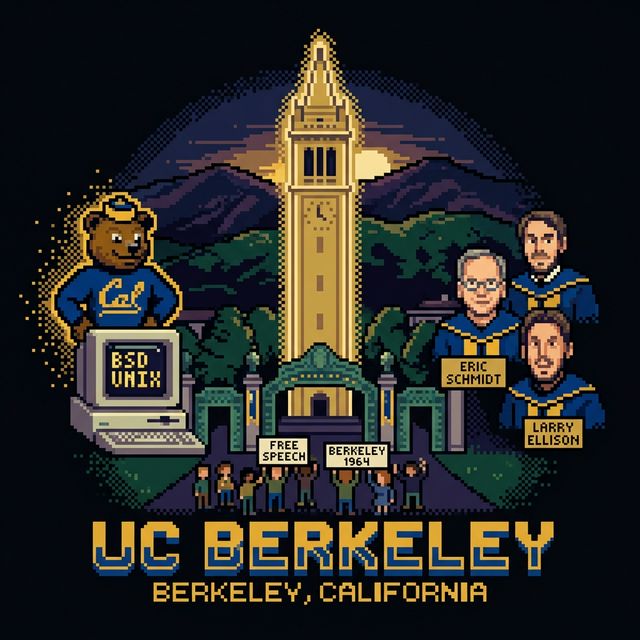
“BSD: the Unix that could be shared.”
The Story
The University of California, Berkeley received a Unix source license from AT&T in 1974. What the Computer Systems Research Group (CSRG) did with it changed the industry permanently. Bill Joy and his colleagues added virtual memory, the fast filesystem, job control, and — most consequentially — Berkeley sockets: the networking API that every TCP/IP application on the internet uses to this day.
BSD Unix became the version of Unix that could be shared. While AT&T's Unix was commercially licensed, Berkeley's modifications were distributed freely to other universities. This created a parallel Unix ecosystem — one where the source code was available, where improvements flowed back to the community, and where a graduate student could read, modify, and redistribute the operating system. The BSD license, which required only attribution, became the template for permissive open-source licensing.
The lineage is direct: BSD Unix produced FreeBSD, NetBSD, and OpenBSD. Apple's macOS and iOS are built on a BSD foundation (Darwin/XNU). Netflix runs on FreeBSD. The PlayStation operating system is based on FreeBSD. Berkeley sockets are the API that every network application calls, on every operating system, in every language.
Why They're in the Hall
Berkeley is in the museum because BSD Unix was where the open-source model was proven viable — and where the security consequences of open, networked systems first became visible. Sendmail, written at Berkeley by Eric Allman, became the most widely used mail server on the internet and also one of the most exploited. The Morris Worm of 1988 exploited a buffer overflow in Berkeley's fingerd daemon. The very openness that made BSD valuable — anyone could read the source — also meant anyone could find the vulnerabilities. Berkeley built the networked Unix that the internet runs on, and in doing so, built the attack surface that the internet defends.