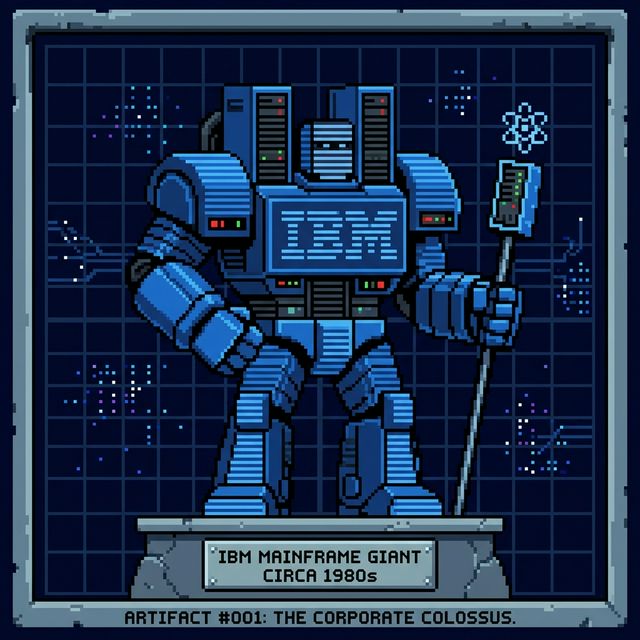
“THINK.”
The Story
International Business Machines did not invent the computer. What IBM did was something arguably more consequential: they made computing into an industry.
The story begins with punch cards and tabulators in the early 1900s, but the defining moment came in 1964 with the System/360. Before the 360, every computer model was a silo — software written for one machine couldn't run on another, even from the same manufacturer. IBM bet the company (a $5 billion investment, roughly $50 billion in today's money) on a radical idea: a family of compatible machines spanning different price points and performance levels, all running the same instruction set. You could write software on the low-end model and run it on the high-end one.
This was the birth of hardware abstraction as a commercial principle. It was also the birth of vendor lock-in as a business strategy. Once your COBOL payroll system ran on IBM iron, migrating to a competitor meant rewriting everything. IBM understood this. Their customers understood this. Everyone proceeded anyway, because the alternative was worse.
The IBM PC in 1981 was the opposite bet — and the opposite outcome. IBM used off-the-shelf components and an open architecture, expecting the IBM brand to maintain their market position. Instead, Compaq reverse-engineered the BIOS within two years, and the clone industry exploded. IBM had inadvertently created a standard that anyone could build, and within a decade they were a minor player in the market they'd launched.
The pivot to services and consulting followed. IBM sold its PC division to Lenovo in 2005 and reinvented itself as a consulting and enterprise services company. The Watson AI push in the 2010s generated more marketing than results. Through it all, the mainframes kept running — quietly processing the majority of the world's credit card transactions, airline reservations, and banking operations.
Why They're in the Hall
IBM occupies the Pioneer and Builder categories with an asterisk the size of a mainframe.
The fame is real. The System/360 is one of the most important engineering achievements in computing history. The concept of a compatible computer family — write once, run on any model in the lineup — laid the conceptual groundwork for every abstraction layer that followed: virtual machines, portable operating systems, containerization. IBM's COBOL implementations and batch processing models became the template for how the entire financial industry processed data. When Grace Hopper standardized COBOL, it was IBM's hardware that ran it at scale.
The shame is equally real. IBM's punch card culture persisted decades past its usefulness, embedding rigid batch-processing assumptions into systems that would outlive the hardware they were designed for. The vendor lock-in model they pioneered is still the playbook for enterprise software companies today. The PC architecture decision that created the clone market was a strategic failure that cost IBM its dominance. And the company's history includes darker chapters — from the controversial role of IBM technology in World War II-era census systems to the repeated cycles of massive layoffs disguised as "resource actions."
The connection to TechnicalDepth is foundational. The 1960s Mainframe and COBOL era documented across this platform is the IBM era. The batch processing patterns, the rigid data structures, the 80-column fixed-width records — these aren't abstract concepts. They're artifacts of IBM hardware constraints that became software traditions that became industry standards that became legacy debt. Every exhibit that traces a pattern back to mainframe-era assumptions is tracing it back to decisions made in Armonk, New York.
IBM didn't just build computing infrastructure. They built the assumptions that computing infrastructure still runs on — for better and for worse.