“DARPA's job is to create and prevent strategic surprise.”
The Story
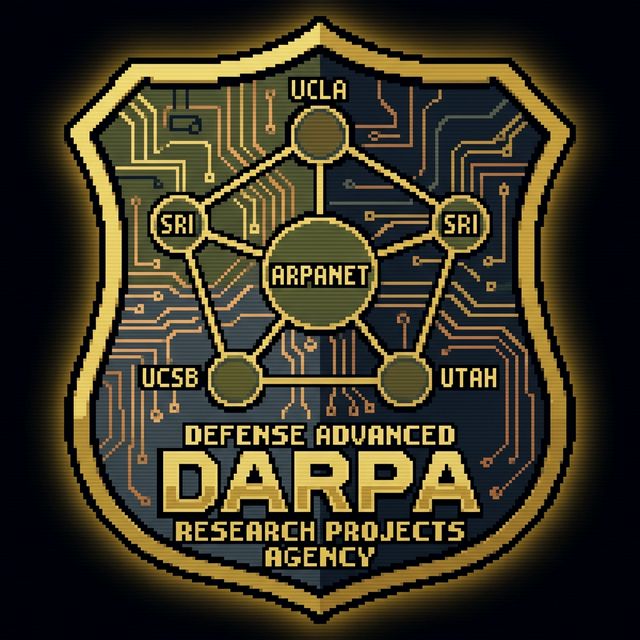
The Defense Advanced Research Projects Agency — originally ARPA, founded in 1958 in response to Sputnik — funded the creation of the internet, timesharing, computer graphics, AI research, and the network protocols that the modern world runs on. ARPANET, the precursor to the internet, went live in 1969 connecting four universities. TCP/IP, designed by Vint Cerf and Bob Kahn under DARPA funding, became the protocol suite that unified the global network.
DARPA's funding model was its innovation: identify brilliant researchers, give them money, and leave them alone. J.C.R. Licklider, who directed ARPA's Information Processing Techniques Office from 1962 to 1964, funded Project MAC at MIT (which produced CTSS and Multics), timesharing research at Berkeley and Stanford, and the networking research that became ARPANET. He didn't direct the research. He funded the people and trusted them to find the problems worth solving.
Why They're in the Hall
DARPA is in the museum because the network it funded — ARPANET, then the internet — was designed for resilience and openness, not security. The original ARPANET had no authentication, no encryption, and no access control because it connected trusted academic institutions. That design assumption — that the network's users were trustworthy — produced the internet's greatest strength (anyone can connect) and its greatest vulnerability (anyone can connect). The Morris Worm of 1988, the first internet pandemic, exploited this trust model. Every network security exhibit in this museum traces back to the architectural decisions made under DARPA funding in the 1960s and 1970s.