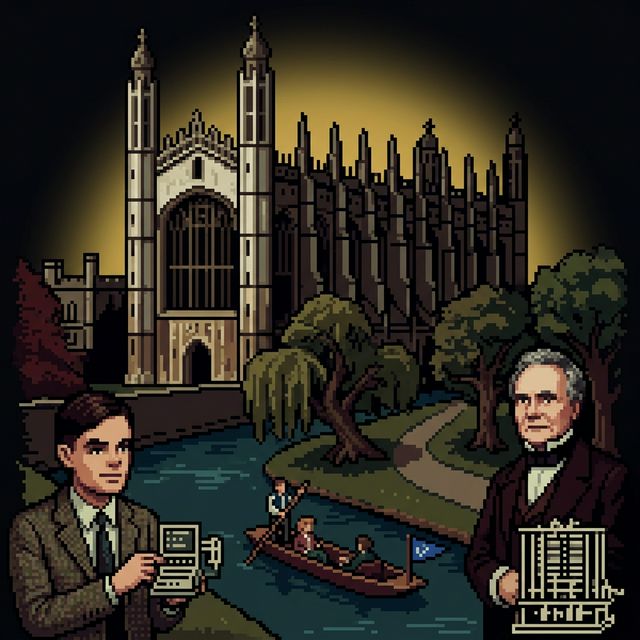
“I can remember the exact instant when I realized that a large part of my life from then on was going to be spent in finding errors in my own programs.”
The Story
On May 6, 1949, EDSAC (Electronic Delay Storage Automatic Calculator) ran its first program at the University of Cambridge — a table of squares. It was the first practical implementation of the stored-program concept: the idea that program instructions and data could both be stored in the same memory and manipulated by the same processor. This was the von Neumann architecture, and every computer built since follows it.
Maurice Wilkes, who led the EDSAC project, had an epiphany while debugging: "I can remember the exact instant when I realized that a large part of my life from then on was going to be spent in finding errors in my own programs." This is the earliest recorded statement of what would become the central problem of software engineering — and the reason this museum exists.
EDSAC's design directly influenced LEO I — J. Lyons & Co. built their business computer based on EDSAC's architecture, making Cambridge the intellectual origin of both academic computing and commercial computing. Wilkes later invented microprogramming, which simplified CPU design and influenced every processor architecture that followed.
Cambridge's modern legacy includes ARM (designed at Cambridge-based Acorn Computers), which powers virtually every smartphone on earth, and the Raspberry Pi (designed at Cambridge's Computer Laboratory), which put a programmable computer in the hands of millions of students.
Why They're in the Hall
Cambridge is in the museum because Wilkes' 1949 realization — that debugging would consume most of a programmer's life — is the founding observation of software archaeology. The stored-program architecture that EDSAC demonstrated is also the architecture that makes buffer overflows possible: if programs and data share the same memory, then data that overwrites program instructions becomes executable. Cambridge built the architecture. The architecture built the vulnerability. Wilkes saw it coming before the first exploit was ever written.