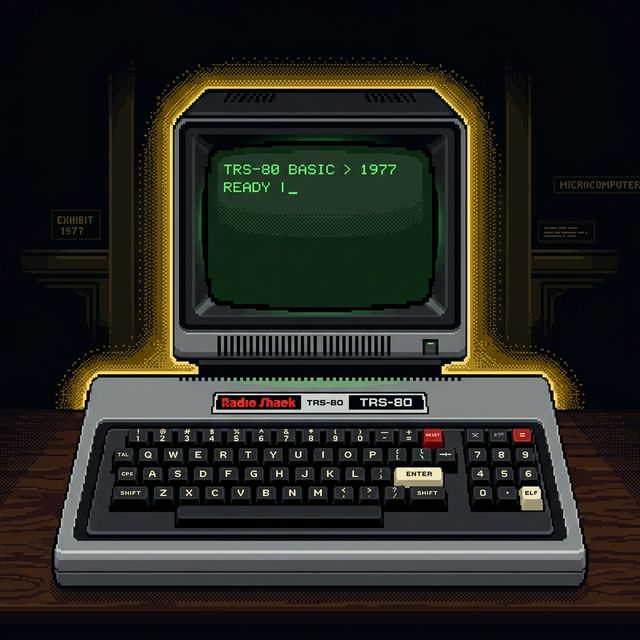
“The TRS-80 was the computer you could buy at the mall. That was not a small thing.”
The Machine
The TRS-80 Model I launched alongside the Apple II and the Commodore PET in 1977 — the "1977 Trinity" of home computers that defined the consumer computing market. Of the three, the TRS-80 was the most accessible: Radio Shack had 3,000 retail stores across the United States. You could walk into a shopping mall, see a TRS-80 demonstration, and buy it that afternoon. Apple and Commodore required specialized dealers or mail order.
The Z80 processor ran at 1.77 MHz. The system included 4KB of RAM standard, expandable to 16KB. Storage was cassette tape. The monitor was a 64-character-wide display. The keyboard could not produce lowercase letters in the original Model I — a cost reduction that frustrated writers and programmers equally, and spawned an entire cottage industry of hardware mods to add lowercase capability.
Why It Matters
The TRS-80's retail availability made it the first computer for hundreds of thousands of Americans who would otherwise not have encountered personal computing. The demographics of who bought a TRS-80 skew toward first-generation computer users: families, teachers, small business owners, hobbyists who walked past a Radio Shack display and stopped out of curiosity.
Many of the programmers, engineers, and executives who built the 1990s and 2000s internet industry wrote their first BASIC programs on a TRS-80 Model I or Model III. The machine's contribution to the museum is not technical — the TRS-80 was behind the Apple II architecturally from day one — it is distributional: it put computing in front of people who would not have found it otherwise.
The Legacy and the Nickname
The TRS-80 was affectionately known as the "Trash-80" by its users — a term applied critically (it crashed, the cassette storage was unreliable, the keyboard was terrible) and affectionately (it was theirs, and it worked, and they built things with it). The nickname is documented here because it is the first instance of a pattern that repeats across computing history: the users who love a platform most are also the ones who know its failure modes most intimately.
The TRS-80 was not the best computer of 1977. It was the one you could buy at the mall. In a field where distribution is destiny, that was enough to launch a generation of programmers.