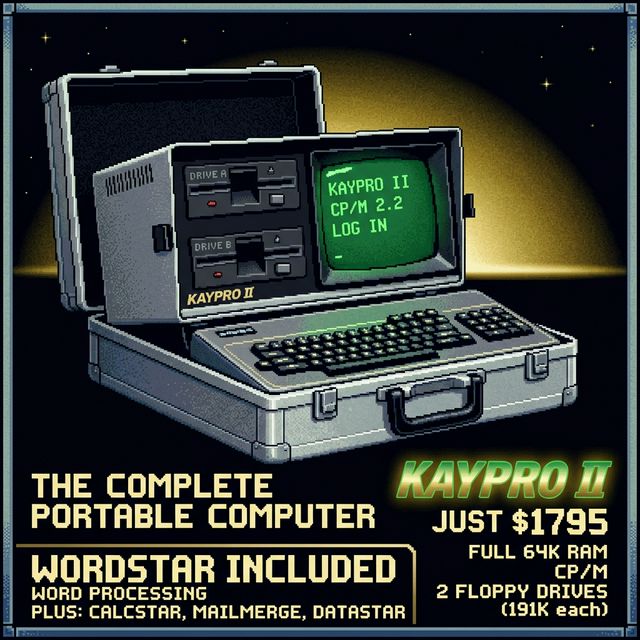
“Kaypro didn't sell a computer. They sold a solution. Every bundled laptop sold since has been doing the same thing.”
The Machine
The Kaypro II was introduced in 1982 by Non-Linear Systems, a California electronics manufacturer. It was a "luggable" computer — portable, in the sense that it had a handle, though at 26 pounds it required a specific commitment to portability. The case was aluminum. The screen was a built-in 9-inch green-phosphor CRT. The Z80 processor ran at 2.5 MHz. Two 191KB floppy drives.
None of this was exceptional for 1982.
The Bundle
What was exceptional was the box. Every Kaypro II shipped with:
- WordStar — the dominant professional word processor of the era
- CalcStar — a spreadsheet
- DataStar — a database manager
- MailMerge — for form letters and mass mailing
- Microsoft BASIC — for programming
These were commercial software products that sold separately for $300-500 each. Kaypro included all of them at a base price of $1,795 — competitive with machines that shipped with no software at all.
The strategy worked because it solved the problem that was preventing office workers from adopting computers: they needed the computer AND the software, and the total cost of both was prohibitive and confusing. Kaypro made the math simple. Buy this box, use it tomorrow.
The Legacy
Kaypro shipped 150,000 units before the IBM PC clone market commoditized the industry and CP/M was displaced by MS-DOS. The company filed for bankruptcy in 1992.
The strategy, however, outlasted the company. The bundled software model — buy the hardware, receive the software — became the standard PC sales approach: Windows bundled with OEM machines, Microsoft Office bundled at corporate pricing, productivity suites as platform anchors. Every modern laptop that ships with trial software is Kaypro's ghost.
The Museum Note
Kaypro is the exhibit on distribution as product: the hardware was not differentiated. The software was not exclusive (competitors could have bundled the same software). The insight was recognizing that customers wanted the combination — not the computer, not the software separately. The product was the bundle. Kaypro's competitors were selling computers. Kaypro was selling a workday.
Kaypro proved that the product isn't the machine. The product is what the machine lets you do. This is still true. The only thing that changed is the form factor.