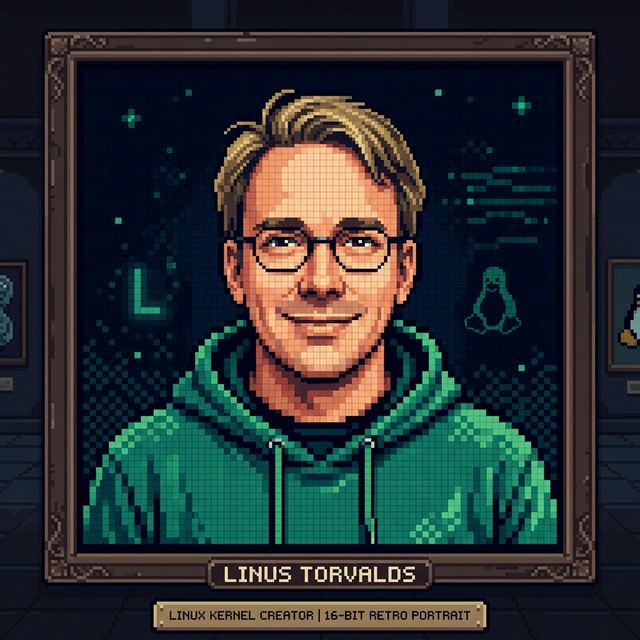
“Talk is cheap. Show me the code.”
The Story
In 1991, a 21-year-old Finnish student posted a message to the comp.os.minix newsgroup: "I'm doing a (free) operating system (just a hobby, won't be big and professional like gnu)." The hobby became Linux — an operating system kernel that now runs on everything from Android phones to the International Space Station, from 90% of the world's cloud servers to the top 500 supercomputers on Earth (all 500 of them).
Torvalds didn't build Linux alone. What he built was a system for building Linux — a governance model, a code review culture, and eventually, a version control system purpose-built for distributed collaboration at massive scale.
Git was born from crisis. In 2005, the Linux kernel project lost access to the proprietary version control system it had been using (BitKeeper). Torvalds, frustrated with every available alternative, wrote Git in roughly two weeks. It was designed around the Linux development model: distributed, fast, capable of handling thousands of contributors working in parallel on a codebase with millions of lines.
Git didn't just replace BitKeeper. It replaced every centralized version control system. GitHub, GitLab, Bitbucket — the entire modern software collaboration stack is built on Torvalds's data model of content-addressable objects and directed acyclic graphs. Today, Git is so ubiquitous that many developers don't realize version control could work any other way.
Torvalds is also famous — or infamous — for his blunt communication style. His code reviews on the Linux kernel mailing list are legendary for their directness, occasionally crossing into personal criticism. He's acknowledged this and stepped away from kernel development temporarily in 2018 to, as he put it, "get some assistance on how to understand people's emotions and respond appropriately." He returned with a more measured tone, though the technical bar remained unchanged.
Why They're in the Hall
Torvalds is a Builder and a Voice. Two separate acts of creation, both foundational.
As a Builder, Linux is the operating system of the internet. Every server-side exhibit in TechnicalDepth runs on Linux or something shaped by it. The kernel's architecture — its process model, its virtual filesystem, its network stack — is the environment in which most modern software operates. Understanding Linux internals isn't optional for serious software archaeology; it's the terrain.
Git is equally foundational, but in a different way. It's the tool through which code history is preserved, examined, and understood. git blame, git log, git bisect — these are the primary instruments of software archaeology. When TechnicalDepth traces the lineage of a flaw, the evidence often lives in Git history.
As a Voice, Torvalds established a culture of direct technical accountability in open source. "Talk is cheap. Show me the code" is more than a quip — it's a philosophy. Claims without evidence get dismissed. Architectures get evaluated by reading the implementation, not the design document. This ethos — that the code is the truth, and everything else is commentary — runs through every exhibit in TechnicalDepth.
His communication style, for better and worse, shaped open source culture for a generation. The direct, sometimes harsh code review model he practiced has been widely adopted, widely criticized, and remains one of the most debated aspects of open source governance. TechnicalDepth doesn't take a side on that debate. It documents patterns. And Torvalds is a pattern.