Museum Wire
Law 0 · Katie's LawEvery system is shaped by the human drive to do less work. This is not a flaw. It is the economic force that produces all software — and all software failure.Law I · Boundary CollapseWhen data crosses into a system that interprets structure, without being constrained, it becomes executable.2026 IncidentAxios. 70 Million Downloads a Week. North Korea Inside.Law II · Ambient AuthorityWhen a system trusts the presence of a credential instead of verifying the intent behind it, authentication becomes indistinguishable from authorization.AXM-001Set Theory — Membership, Boundaries, and BelongingLaw III · Transitive TrustWhen a system inherits trust from a source it did not verify, the attack surface extends to everything that source touches.2026 IncidentClaude Code — The Accept-Data-Loss FlagLaw IV · Complexity AccretionSystems do not become complex. They accumulate complexity — one reasonable decision at a time — until no single person can hold the whole in their head.Law V · Temporal CouplingCode that assumes sequential execution, stable state, or consistent timing will fail the moment concurrency, scale, or latency proves the assumption wrong.2026 IncidentCopy Fail — 732 Bytes to Root on Every Linux DistributionAXM-002Boolean & Propositional Logic — True, False, and the Excluded MiddleLaw VI · Observer InterferenceWhen the system that monitors health becomes a participant in the system it monitors, observation becomes a failure vector.2025Operation Chrysalis: The Notepad++ Supply Chain Hijack2025Replit Agent — The Vibe Code Wipe2024Air Canada Chatbot — The Policy That Wasn't2024Change Healthcare — One-Third of US Healthcare, One Missing MFA2024CrowdStrike — The Security Update That Broke the World2024Google Gemini Image Generation — The Six-Day Pause2024XZ Utils — The Two-Year Infiltration20233CX — The Supply Chain That Ate Another Supply Chain2023Amazon Prime Video — The Per-Frame State Machine2023Bing Sydney — The Chatbot That Went Rogue2023Samsung ChatGPT Leak — The Employee Who Pasted the Secret2022Meta Galactica — The Three-Day Scientific Oracle2021Colonial Pipeline — When Billing Shut Down the FuelEFFODE · LEGE · INTELLEGELaw 0 · Katie's LawEvery system is shaped by the human drive to do less work. This is not a flaw. It is the economic force that produces all software — and all software failure.Law I · Boundary CollapseWhen data crosses into a system that interprets structure, without being constrained, it becomes executable.2026 IncidentAxios. 70 Million Downloads a Week. North Korea Inside.Law II · Ambient AuthorityWhen a system trusts the presence of a credential instead of verifying the intent behind it, authentication becomes indistinguishable from authorization.AXM-001Set Theory — Membership, Boundaries, and BelongingLaw III · Transitive TrustWhen a system inherits trust from a source it did not verify, the attack surface extends to everything that source touches.2026 IncidentClaude Code — The Accept-Data-Loss FlagLaw IV · Complexity AccretionSystems do not become complex. They accumulate complexity — one reasonable decision at a time — until no single person can hold the whole in their head.Law V · Temporal CouplingCode that assumes sequential execution, stable state, or consistent timing will fail the moment concurrency, scale, or latency proves the assumption wrong.2026 IncidentCopy Fail — 732 Bytes to Root on Every Linux DistributionAXM-002Boolean & Propositional Logic — True, False, and the Excluded MiddleLaw VI · Observer InterferenceWhen the system that monitors health becomes a participant in the system it monitors, observation becomes a failure vector.2025Operation Chrysalis: The Notepad++ Supply Chain Hijack2025Replit Agent — The Vibe Code Wipe2024Air Canada Chatbot — The Policy That Wasn't2024Change Healthcare — One-Third of US Healthcare, One Missing MFA2024CrowdStrike — The Security Update That Broke the World2024Google Gemini Image Generation — The Six-Day Pause2024XZ Utils — The Two-Year Infiltration20233CX — The Supply Chain That Ate Another Supply Chain2023Amazon Prime Video — The Per-Frame State Machine2023Bing Sydney — The Chatbot That Went Rogue2023Samsung ChatGPT Leak — The Employee Who Pasted the Secret2022Meta Galactica — The Three-Day Scientific Oracle2021Colonial Pipeline — When Billing Shut Down the FuelEFFODE · LEGE · INTELLEGE
Keyboard Navigation
W
A
S
D
or arrow keys · M for map · Q to exit
← Back to Hall of Heroes
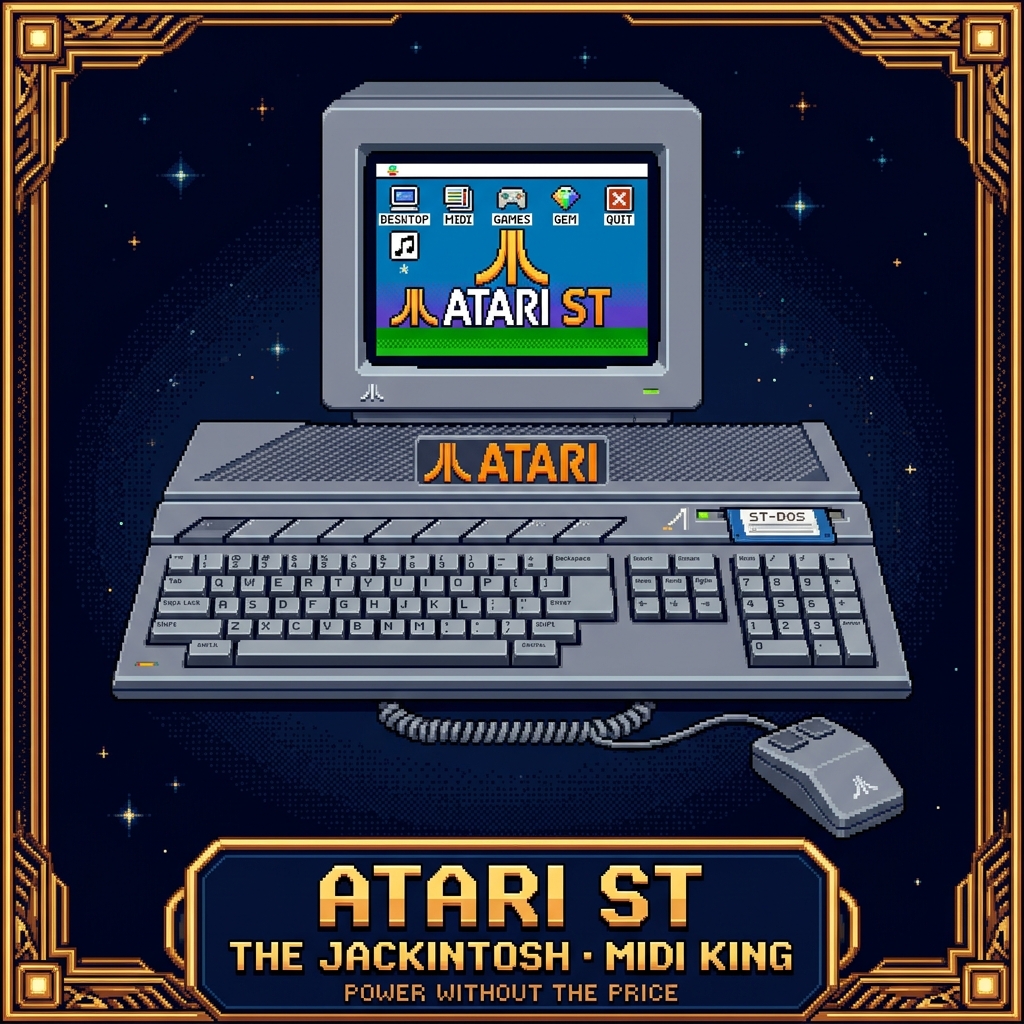
Atari ST pixel portrait
⬡ Pioneerfame

Atari ST

Atari ST

The MIDI King and the Price of Performance

eighties · 3 min read · Decommissioned
Power without the price. The machine that brought the 16-bit graphical desktop to the masses.

The Machine

Launched in 1985, the Atari ST (ST standing for Sixteen/Thirty-two, referencing the 68000's internal bus) was Atari's response to the 16-bit revolution. It was the first computer with a bitmapped color GUI integrated into its operating system (TOS/GEM) and the first to include built-in MIDI ports.

The "Jackintosh" moniker was a nod to both Jack Tramiel's aggressive pricing strategy and the machine's perceived rivalry with the Apple Macintosh. Tramiel, having left Commodore under acrimonious circumstances, acquired Atari and pushed for a machine that could under-cut the Macintosh while providing comparable graphical power.

The MIDI King

The Atari ST's most enduring legacy is its dominance in the music industry. By including MIDI (Musical Instrument Digital Interface) ports directly on the motherboard, Atari turned every ST into a professional sequencer. This decision alone ensured the machine's longevity long after its graphical capabilities were surpassed.

The hardware was remarkably stable for real-time MIDI processing, leading to the development of legendary software like C-Lab Creator (the ancestor of Logic Pro) and Cubase. For a decade, the Atari ST was the brain of virtually every professional recording studio and electronic music stage.

The GEM Desktop

The Graphics Environment Manager (GEM) provided a WIMP (Windows, Icons, Menus, Pointers) interface that felt familiar to Macintosh users but ran on significantly cheaper hardware. While the Macintosh was monochromatic at launch, the Atari ST offered color graphics and high-resolution monochrome options that were favored by desktop publishers and programmers.

The underlying TOS (The Operating System) was stored in ROM, meaning the machine booted almost instantly to the desktop — a sharp contrast to contemporary PCs that required floppy-disk loading for the OS.

The Architecture

While it lacked the highly specialized custom chips of its rival, the Commodore Amiga, the Atari ST relied on a fast Motorola 68000 CPU and a clean, straightforward memory map. Later models introduced the "Blitter" chip to accelerate graphical operations, but the machine's strength was always its balance of raw CPU speed and specialized I/O.

The ST's monochrome high-resolution mode (640x400) was exceptionally crisp for its time, making it a favorite for C development and MIDI sequencing where screen real estate and legibility were paramount.

The Atari ST didn't need to be the most complex machine; it needed to be the most accessible. By putting MIDI ports on a consumer computer, Atari accidentally created the foundation of modern electronic music.