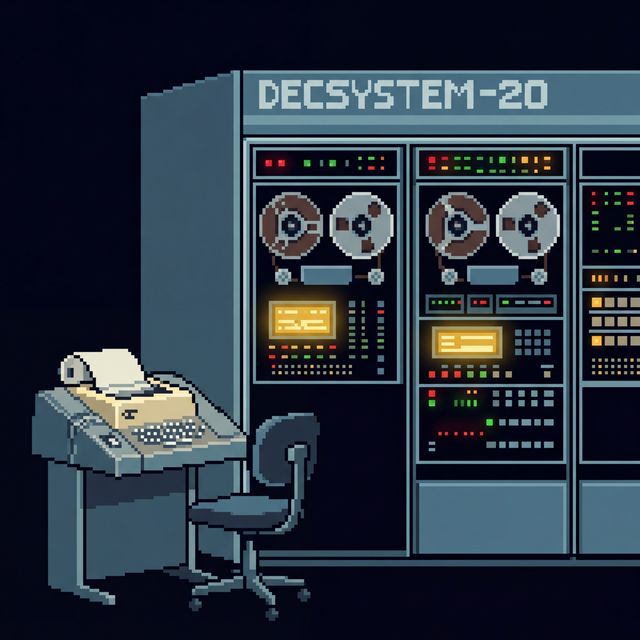
“You could tell how good a programmer was by whether they had a login on the AI lab PDP-10.”
The Machine
The PDP-10 was introduced by Digital Equipment Corporation in 1966. Its 36-bit word size was not an accident: 36 bits is evenly divisible by 6 (for 6-bit characters), by 9 (for 9-bit bytes), and allowed efficient representation of both text (packed characters) and floating-point numbers. The architecture was designed by Gordon Bell and others who had thought carefully about what a general-purpose computing machine should optimize for.
TOPS-10 and TOPS-20 (via the TENEX operating system from BBN) gave the PDP-10 powerful timesharing and interactive capabilities. Multiple users could log in simultaneously, run programs independently, and share files. This sounds obvious today. In the 1960s, it was radical — computers were batch-processing machines that ran one job at a time from a card reader queue.
Where Hacker Culture Was Born
MIT's Project MAC (Mathematics and Computation) ran on a PDP-10. The MIT AI Lab ran on PDP-10s into the 1980s. SAIL (Stanford Artificial Intelligence Laboratory) ran on a DECSYSTEM-20. These machines were the common ground of the early hacker community — the people who would go on to create Unix, Emacs, Lisp, the TCP/IP stack, and the foundations of the modern internet.
The interactive timesharing environment created by the PDP-10 operating systems was conducive to a specific working style: exploratory, immediate, collaborative. You could test a function interactively. You could read other users' code (if they hadn't set file protections — and often they hadn't, because sharing was the norm). You could leave programs running and come back. The culture of "release early, share widely, improve collaboratively" that the open-source movement formalized was simply the normal working environment on a PDP-10.
Emacs — the extensible text editor that remains in active use today — was first written for a PDP-10 at MIT in 1976. MACLISP, the dialect of Lisp that led directly to Common Lisp and influenced JavaScript, Scheme, and Python, ran on PDP-10s. Zork, the text adventure game that launched the interactive fiction genre, was written on a PDP-10 at MIT.
The Death
DEC discontinued PDP-10 development in 1983, prioritizing the VAX architecture. The MIT AI Lab held a funeral for their PDP-10 (named "ITS" — Incompatible Timesharing System). Richard Stallman, who had spent years on the MIT AI Lab PDP-10, responded to the machine's death and the proprietary software that replaced it by beginning work on the GNU Project — a free software operating system. The death of the PDP-10 is the direct ancestor of the free software movement.
The PDP-10 was not replaced because it was inferior. It was replaced because DEC made a business decision. The hackers who lost access to it built the internet instead. The outcome was not planned. It was a consequence.