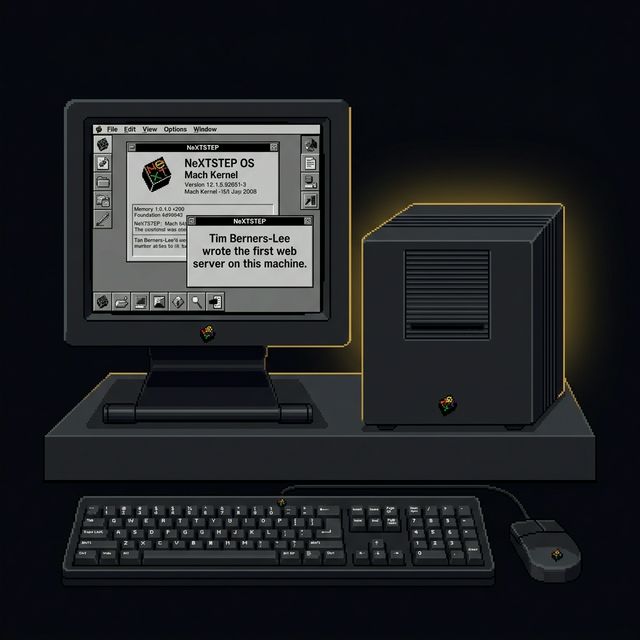
“The NeXT shall inherit the earth.”
The Story
NeXT, Inc. was founded by Steve Jobs in 1985 after his departure from Apple. The NeXT Computer (1988) was a commercial failure — too expensive for universities, too niche for enterprise. But NeXTSTEP, its operating system, was a technical masterpiece: a Unix-based OS with an object-oriented application framework, Display PostScript rendering, and Interface Builder — the first visual tool for building graphical user interfaces by dragging and connecting objects.
In 1990, Tim Berners-Lee used a NeXT Computer at CERN to build the first web browser (WorldWideWeb.app) and the first web server (httpd). The web was born on NeXTSTEP. The URL bar, the hyperlink, the concept of "view source" — all were first implemented on a NeXT workstation.
When Apple acquired NeXT in 1996 for $429 million, NeXTSTEP became the foundation of Mac OS X (now macOS), which became the foundation of iOS, watchOS, and tvOS. The Objective-C runtime, the AppKit/UIKit frameworks, Xcode's Interface Builder, and the entire Apple developer ecosystem descend directly from NeXTSTEP.
Why They're in the Hall
NeXT is in the museum because the web was built on it and the Apple ecosystem grew from it. Every XSS attack, every CSRF exploit, every web vulnerability documented in the Web Gallery floor of this museum executes in a context that was first created on a NeXT workstation in Geneva. And every iOS app, every macOS application, every Swift program traces its framework lineage to NeXTSTEP's Objective-C runtime. NeXT failed as a product and succeeded as the substrate for two of the most consequential platforms in computing history.