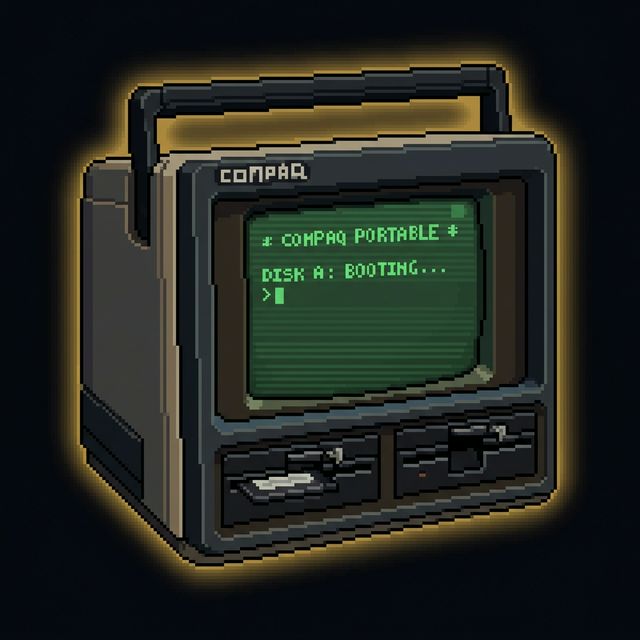
“We didn't steal anything. We reverse-engineered it, documented every step, and beat them in court. That's how innovation works.”
The Napkin
In 1981, Rod Canion, Jim Harris, and Bill Murto were engineers at Texas Instruments, frustrated by TI's direction. They met at a House of Pies restaurant in Houston to discuss starting a company. Canion sketched a design for a portable IBM-PC-compatible computer on a paper placemat. The sketch showed a sewing machine-style briefcase form factor with a flip-up display.
They raised $1.5 million from venture capital and started Compaq Computer Corporation in 1982.
The critical engineering challenge was not the hardware. It was the BIOS — the Basic Input/Output System, the firmware layer between the operating system and the hardware. IBM's BIOS was copyrighted. Using it directly was infringement. The solution was clean-room reverse engineering: two teams, completely separated with no communication, documented only by a specification written from IBM's public documentation. Team A analyzed IBM's BIOS and wrote a complete functional specification of what it did, without any IBM code. Team B, who had never seen the IBM BIOS, wrote a new BIOS that matched Team A's specification.
Compaq's lawyers documented every step of this process specifically to demonstrate in court that no IBM code was used. The strategy held. IBM sued. Compaq won.
What the Clone Created
The Compaq Portable shipped in 1982, the same year the company was founded. It weighed 28 pounds, displayed text on a 9-inch CRT, ran MS-DOS, and was fully IBM-compatible. It ran every IBM PC program. It sold 53,000 units in its first year — $111 million in revenue, a first-year record at the time.
The clone market that followed destroyed IBM's hardware leverage. Once compatible PCs could be built legally, the price war was inevitable. By the mid-1980s, dozens of manufacturers were producing IBM-compatible PCs. IBM had contributed the architecture. It could not charge rent on it. The economic value migrated to Microsoft (the software) and Intel (the processor), both of which IBM had allowed to sell to third parties in the original deal.
Compaq was acquired by HP in 2002.
The Exhibit
Compaq's story is the museum's exhibit on unintended architectural consequence: IBM designed a modular, open-architecture PC — because that was faster to ship — and didn't foresee that the modularity made it legally cloneable. The architecture that allowed IBM to launch quickly is the architecture that made IBM's competitive position impossible to defend.
IBM opened the architecture to ship faster. Compaq opened the market to compete. The lesson is not that IBM was wrong. The lesson is that architectural decisions carry competitive consequences their designers don't control.