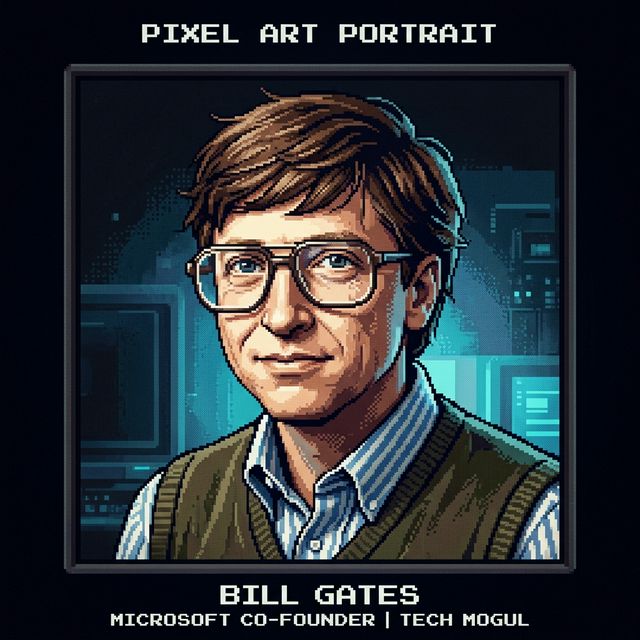
“In terms of doing things I take a fairly scientific approach to why things happen and how they happen. I don't think anything will happen just because I line up and clap my hands.”
The Story
In January 1975, a Harvard sophomore named Bill Gates and his childhood friend Paul Allen saw the Altair 8800 on the cover of Popular Electronics. They called MITS, the manufacturer, and claimed they had a BASIC interpreter ready for it. They didn't. Allen flew to Albuquerque while Gates wrote the interpreter — a version of BASIC that had to fit in 4 kilobytes of memory and run on a processor neither of them had physically touched. It worked on the first demonstration.
Microsoft BASIC was a direct descendant of the language Thomas Kurtz and John Kemeny created at Dartmouth. Gates and Allen adapted it for the microcomputer era, and it shipped on nearly every early personal computer: the Altair, the Apple II (as Applesoft BASIC), the Commodore 64, the TRS-80. If you learned to program in the late 1970s or early 1980s, you almost certainly learned on a Microsoft BASIC variant. The lineage runs from Dartmouth BASIC through Microsoft BASIC to GW-BASIC to QBasic to Visual Basic to VB6 — and the patterns VB6 developers baked into enterprise software populate the Greedy Initializer exhibit.
The MS-DOS licensing deal with IBM in 1981 was the inflection point. Gates didn't sell IBM an operating system; he licensed it, retaining the right to sell MS-DOS to other manufacturers. When the IBM PC clone market exploded, Microsoft collected royalties on every machine. It was a business architecture decision with the leverage characteristics of a platform play — and it made Microsoft the most powerful company in computing.
Windows extended that dominance into the GUI era. By the mid-1990s, Windows ran on over 90% of personal computers. This market position meant that every design decision Microsoft made — good or bad — became a de facto standard. When those decisions were sound, billions of users benefited. When they weren't, billions of users were exposed.
The browser wars revealed the cost of that dominance. Internet Explorer, bundled with Windows starting in 1995, crushed Netscape through integration rather than competition. IE6, released in 2001, became the dominant browser by default — and then Microsoft stopped developing it. For five years, the browser that ran the internet received no major updates. IE6's monoculture became the single largest attack surface in computing history. ActiveX controls — downloadable binary components that ran with full system privileges — were a mechanism for drive-by malware installation at industrial scale. The "Embrace, Extend, Extinguish" strategy that antitrust regulators documented wasn't just anti-competitive; it created a security catastrophe by freezing the web's primary runtime in 2001.
The reckoning came in January 2002. After the Code Red and Nimda worms ravaged Windows systems worldwide, Gates sent the "Trustworthy Computing" memo to every Microsoft employee. It was unprecedented: the CEO of the world's largest software company halted feature development on Windows to focus on security. The memo acknowledged, in writing, that Microsoft had shipped insecure defaults for years and that trust was more important than new features.
The memo was genuine. The security push that followed produced significant improvements: Windows XP SP2 turned on the firewall by default, enabled automatic updates, and introduced the Security Development Lifecycle (SDL). Vista, for all its unpopularity, was architecturally more secure than any previous Windows version. The trajectory from the Trustworthy Computing memo to modern Windows security is real and measurable. But it took a crisis — worms spreading across millions of machines — to trigger a pivot that should have started years earlier.
Why They're in the Hall
Gates is a Pioneer and Builder whose impact on TechnicalDepth is both structural and cautionary.
Pioneer: Microsoft BASIC put a programming language in front of more people than any product before it. The personal computer revolution had hardware; Gates and Allen gave it software. The BASIC interpreter they wrote for the Altair established the pattern that defined Microsoft's next five decades: write the software layer that makes hardware useful, then make that layer ubiquitous. This is platform architecture as business strategy, and nobody has ever executed it at the scale Gates achieved.
The BASIC lineage connects directly to TechnicalDepth's exhibits. Dartmouth BASIC begat Microsoft BASIC, which begat Visual Basic, which begat VB6, which powered an entire generation of enterprise applications built by developers who learned to program through the accessibility-first paradigm Kurtz designed and Gates commercialized. The Greedy Initializer exhibit documents patterns that emerged from this lineage — initialization logic that made perfect sense in VB6's rapid-development model and became technical debt when the applications outlived their expected lifespan by decades.
Builder: Windows is infrastructure. Not elegant infrastructure, not minimal infrastructure, but infrastructure that runs on a billion machines. The decisions Gates made about Windows architecture — the registry, the DLL model, the COM/ActiveX component system, the way drivers interact with the kernel — shaped the computing environment that most of the world's business software was built for. Those decisions are still present in every Windows machine shipping today.
The "both" in fame_or_shame is essential, not a hedge. Gates built the platform that democratized computing and the platform that made everyone vulnerable. IE6 and ActiveX are not separate from Microsoft BASIC and the Trustworthy Computing memo — they're different outputs of the same philosophy: ship widely first, secure later. The 2002 memo was the moment Gates acknowledged that the "secure later" part couldn't be deferred indefinitely. The five years of IE6 stagnation was the cost of learning that lesson. The modern Windows security stack is the evidence that the lesson was eventually learned.
The Gates arc — from building a BASIC interpreter in a dorm room to halting Windows development to fix security — is a compressed version of the entire software industry's relationship with security. Build fast, ship widely, defer the hard problems, then scramble when the consequences arrive. TechnicalDepth documents the consequences. Gates created the platform where most of them occurred.