“The wind of freedom blows.”
The Story
Stanford University was ARPANET node #2 — the second institution connected to the network that became the internet. The Stanford Artificial Intelligence Laboratory (SAIL), founded by John McCarthy in 1963, was one of the original AI research centers and produced foundational work in natural language processing, computer vision, and robotics. The Stanford Research Institute (SRI) hosted the "Mother of All Demos" in 1968, where Douglas Engelbart demonstrated the mouse, hypertext, videoconferencing, and collaborative editing — decades before any of these became products.
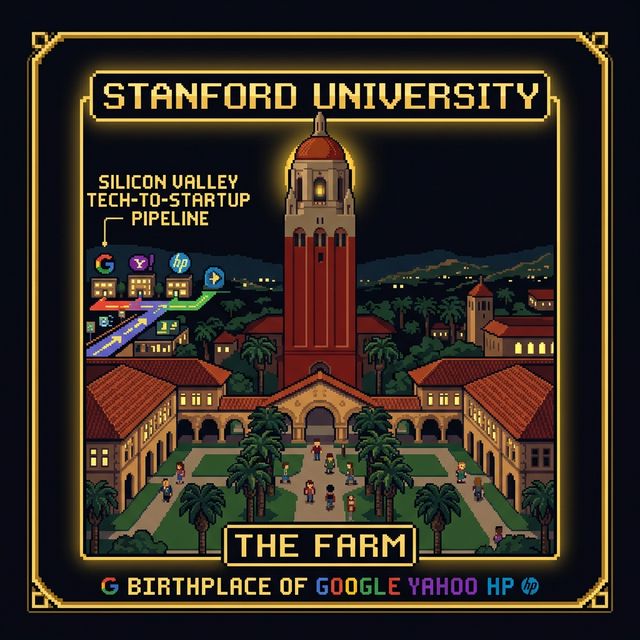
But Stanford's defining contribution to the software industry is cultural, not technical. Frederick Terman, dean of engineering, encouraged students and faculty to start companies in the area around the university. Hewlett-Packard (1939), Varian Associates, and the semiconductor companies that gave Silicon Valley its name all trace to Stanford's ecosystem. Google was a Stanford research project. Yahoo was a Stanford student directory. Sun Microsystems was named for the Stanford University Network. Cisco's founders were Stanford staff.
Why They're in the Hall
Stanford is in the museum because it created the pipeline from academic research to commercial software — and that pipeline's speed is the engine behind Katie's Law. The pressure to ship, to scale, to capture market — the economic force that selects for the lazier path — is a direct product of the venture-funded startup culture that Stanford's ecosystem created. The shortcuts documented in this museum are taken under pressure, and Stanford built the system that creates the pressure. The AI exhibits on the Frontier floor — The Instructed Hallucination, The Autonomous Executor — descend from research that began at the Stanford AI Lab sixty years ago.