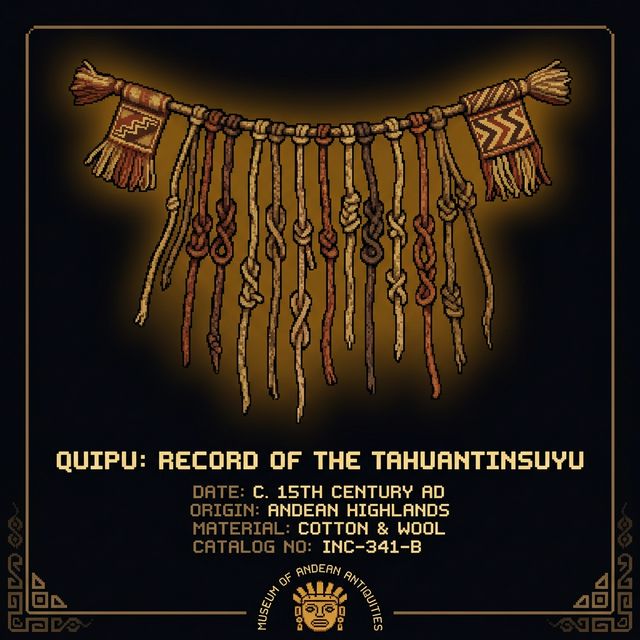
“The quipu is a database we cannot read because we lost the schema. Every deprecated API without documentation is a quipu.”
The Device
A quipu is a main cord, suspended horizontally, from which pendant cords hang. Each pendant cord may have subsidiary cords. Each cord may have sub-subsidiary cords. The hierarchy can extend multiple levels. Knots on each cord encode numbers in a decimal positional system: knot position indicates magnitude (ones, tens, hundreds, thousands), knot type indicates digit (figure-eight knot for 1, long knot with number of turns for 2-9, and so forth). Cord color and ply direction carry additional information.
The Inca Empire administered a territory of 2 million square kilometers — running from present-day Colombia to Chile — without writing, using quipus maintained by trained specialists called quipucamayocs. Census records, tax collection, military logistics, agricultural inventories: all managed through the knotted string system.
The Schema Problem
Here is the exhibit: archaeologists can read the numerical quipus. The positional encoding is mathematically consistent and has been decoded. When a quipu contains pure decimal number sequences, modern scholars can read them.
Approximately 20% of surviving quipus do not follow the numerical schema. Their knot patterns are consistent — they are clearly encoding something systematically — but the encoding has not been recovered. These may be narrative quipus, encoding historical events, official decrees, or information categories scholars haven't identified. Or the schema may have been carried in the quipucamayoc tradition, passed orally, and died with the tradition.
The Spanish colonizers explicitly destroyed quipus as part of the suppression of Incan culture. Document destruction as epistemicide. The schema for the non-numerical quipus may have survived intact until the 16th century and was then deliberately eliminated.
The Museum Lesson
The quipu is the oldest example of data without documentation: a complex, internally consistent encoding system where the data survives and the schema does not. Every organization that has ever inherited a database with no data dictionary, every developer who has opened a legacy system with no README, every archaeologist of broken software has stood in the same position as the scholars staring at a non-numerical quipu.
The data is there. The encoding is systematic. The key is gone.
Katie's Law: it was too much work to write down what the knots meant. The quipucamayocs knew. They would always know. And then they didn't.