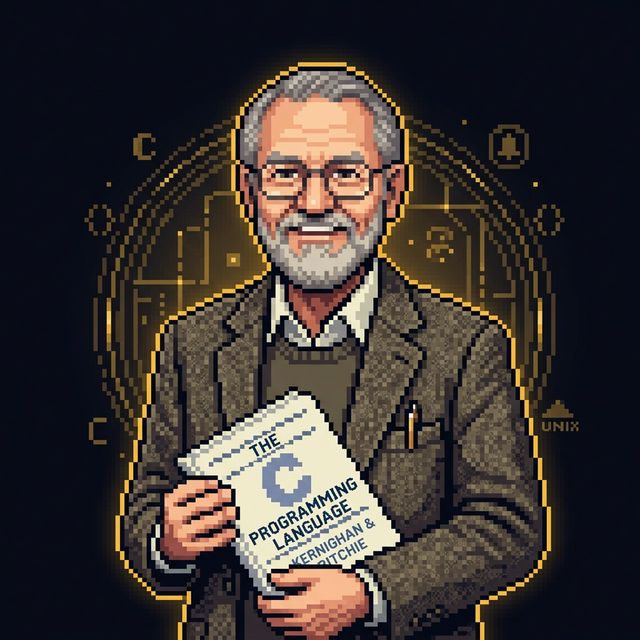
“Debugging is twice as hard as writing the code in the first place. Therefore, if you write the code as cleverly as possible, you are, by definition, not smart enough to debug it.”
The Story
Dennis Ritchie created the C programming language. Brian Kernighan taught it to the world.
In 1978, Kernighan and Ritchie published The C Programming Language — known universally as "K&R." It is 228 pages long. It covers the entire language. It is clear, precise, and ruthlessly concise. Every example compiles. Every explanation says exactly what it needs to and nothing more. For millions of programmers over four decades, K&R was the first serious programming book they read, and no subsequent book quite matched it.
The book opens with a program that prints "hello, world" to the screen. Kernighan had used this example in earlier documentation — a 1974 Bell Labs internal memo on the B programming language — but K&R cemented it as the universal tradition. Every programming language tutorial, every "getting started" guide, every first day in every computer science classroom begins with Hello, World. It's Kernighan's example. It's the first line of code most programmers ever write.
Kernighan didn't create C. He'd be the first to tell you that. Ritchie designed the language, wrote the compiler, and made the fundamental technical decisions. What Kernighan did was recognize that a powerful tool is only as valuable as people's ability to learn it, and he wrote the book that made C learnable. This is not a minor contribution. Programming languages live or die by their ecosystems, and documentation is the gateway to the ecosystem. C became the dominant systems programming language in part because K&R existed — because there was a single, authoritative, well-written source that a programmer could sit down with and emerge, 228 pages later, competent.
But Kernighan's contributions extend well beyond one book.
AWK (1977) — created with Alfred Aho and Peter Weinberger — is a text-processing language designed for Unix pipelines. It reads input line by line, splits each line into fields, and applies pattern-action rules. It is small. It is fast. It does one thing extremely well. Nearly fifty years later, AWK is still installed on every Unix-like system, still used in shell scripts, still the fastest way to extract a column from a log file or transform structured text. It survives because it solves a real problem with minimal complexity — the Unix philosophy incarnate.
At Bell Labs, Kernighan worked alongside Thompson, Ritchie, Pike, and the rest of the Unix group during the most productive period in the history of software engineering. He contributed to Unix documentation, wrote tools, and co-authored papers that shaped how the field understood what it was building. His 1984 book with Rob Pike, The Unix Programming Environment, remains one of the best explanations of the Unix philosophy ever written.
After Bell Labs, Kernighan joined Princeton University, where he has spent decades teaching computer science to undergraduates. He continues to write — books on programming, on technology literacy, on how the digital world works. His 2017 book Understanding the Digital World is aimed at non-technical readers. His commitment to making complex ideas accessible has never wavered.
Why They're in the Hall
Kernighan is Pioneer, Builder, and Voice — and the Voice designation is where his unique contribution lies.
As a Pioneer and Builder, his credentials are established by proximity and participation: he was there at Bell Labs during the Unix era, co-created AWK, contributed to the tools and documentation that defined the Unix ecosystem. AWK alone would be a meaningful legacy — it's still a daily-use tool in every systems programmer's toolkit.
But it's as a Voice that Kernighan earns his singular place. He is the bridge between the people who build systems and the people who need to understand them. K&R is the proof that technical writing can be both rigorous and readable, that precision does not require obscurity, that a 228-page book can teach a complete programming language without dumbing anything down.
His famous debugging quote — that writing clever code makes you, by definition, unable to debug it — is one of the most practical insights in software engineering. It's not a call for mediocrity. It's a call for humility. Write code that's simpler than the most complex thing you can understand, because debugging requires even more cognitive capacity than writing. Leave yourself headroom. This principle underlies TechnicalDepth's entire complexity domain: systems fail when they exceed their maintainers' ability to reason about them.
The connection to Dennis Ritchie is inseparable, and intentionally so. They literally wrote the book together. Ritchie built the language; Kernighan built the on-ramp. In TechnicalDepth's framework, this represents a pattern that recurs throughout computing history: breakthrough tools need breakthrough documentation. Git had Pro Git. Ruby had Why's Poignant Guide. Python had the official tutorial. But C had K&R first, and K&R set the standard.
Kernighan's ongoing work as a teacher — now in his eighties, still at Princeton, still writing, still explaining — embodies a value TechnicalDepth takes seriously: knowledge that isn't transmitted is knowledge that's lost. The patterns in the museum exist because people like Kernighan wrote them down clearly enough that the next generation could learn from them. Every exhibit in TechnicalDepth that includes a "further reading" section owes a philosophical debt to the man who proved that clear technical writing is not a nice-to-have. It's infrastructure.