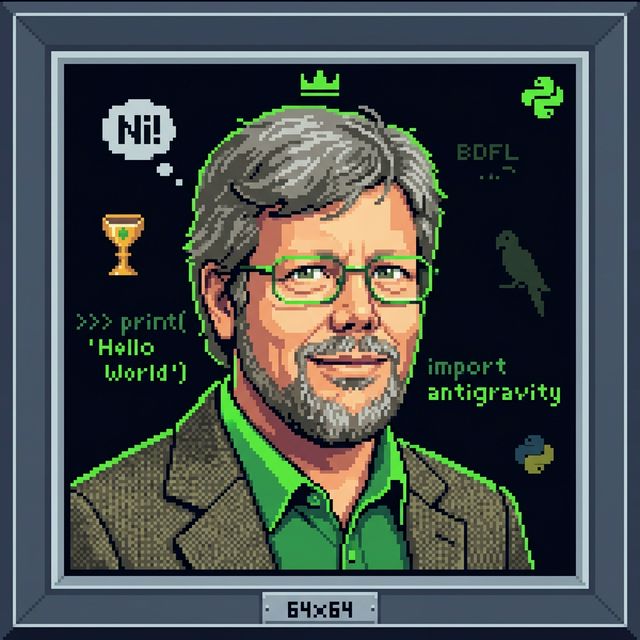
“Code is read much more often than it is written.”
The Story
Over Christmas break in 1989, Guido van Rossum — a Dutch programmer at Centrum Wiskunde & Informatica in Amsterdam — started writing a new programming language. He was frustrated with ABC, a language he'd helped implement that had good ideas but poor extensibility. He wanted something that kept ABC's readability but could actually be used for real systems work.
Python 0.9.0 was released to alt.sources in February 1991. It had classes, exception handling, functions, and the feature that made people either love it or dismiss it immediately: significant whitespace. Indentation wasn't style — it was syntax. If your code wasn't properly indented, it wouldn't run.
This was radical. Every other language used braces or keywords to delimit blocks. Whitespace was cosmetic. Van Rossum made it structural, based on a simple observation: good programmers already indent their code consistently. Why maintain two parallel systems — indentation for humans and braces for the compiler — when you could merge them?
The Python community coalesced around "The Zen of Python," a set of aphorisms written by Tim Peters that captured van Rossum's design philosophy: Beautiful is better than ugly. Explicit is better than implicit. Simple is better than complex. Readability counts. And the most pointed one: There should be one — and preferably only one — obvious way to do it. That last principle was a direct response to Perl's "There's more than one way to do it" — a philosophical rejection of the idea that expressiveness through variety was a virtue.
Van Rossum governed Python as its "Benevolent Dictator For Life" (BDFL) from its creation until 2018, when he stepped down after a contentious debate over the walrus operator (:=). The title was half-joke, half-accurate — his taste and judgment shaped every major design decision for nearly 30 years.
Python's growth was slow and then sudden. It found niches in scripting, then web development, then scientific computing, then data science, then machine learning. By the 2020s, it was the most popular programming language in the world — not because it was the fastest, or the most powerful, or the most elegant, but because it was the most readable. New developers could learn it. Experienced developers could maintain each other's code. The language's constraints — no braces, no semicolons, one obvious way — reduced the surface area for stylistic disagreements that plague other ecosystems.
Why They're in the Hall
Van Rossum is a Pioneer and Builder who proved a counterintuitive thesis: that constraining a language makes it more powerful in practice.
Pioneer: The idea that readability is a design principle — not a nice-to-have, not a style guide concern, but a fundamental property of the language itself — was van Rossum's contribution to language design philosophy. His observation that "code is read much more often than it is written" sounds obvious now. In 1991, it wasn't. Languages were designed for the writer's convenience, for the compiler's efficiency, for theoretical elegance. Van Rossum designed for the reader. Every language since has had to reckon with that choice.
Builder: Python is infrastructure in the same way C++ is, but in a different layer. It's the glue language, the prototyping language, the "get it working first" language. Machine learning runs on Python. Data pipelines run on Python. Automation scripts, web applications, scientific simulations — Python's "batteries included" philosophy and readable syntax made it the default choice for an extraordinary range of domains.
The complexity trade-off is real. Python's readability comes at the cost of performance. The Global Interpreter Lock (GIL) limits true parallelism. Dynamic typing means entire categories of bugs that statically typed languages catch at compile time only surface at runtime. Van Rossum knew these costs. He chose them deliberately, betting that developer productivity and code maintainability mattered more than raw execution speed for most use cases. For two decades, that bet has paid off.
The deeper lesson for TechnicalDepth is about what you optimize for. Every language is a set of trade-offs. Van Rossum optimized for human cognition — for the limited working memory and pattern-matching tendencies of the person reading the code six months later. That's the same person whose cognitive limits produce the patterns documented in the Exhibits wing.