“Writing was not invented to record poems. It was invented to record debts. Every database has the same origin story.”
The Device
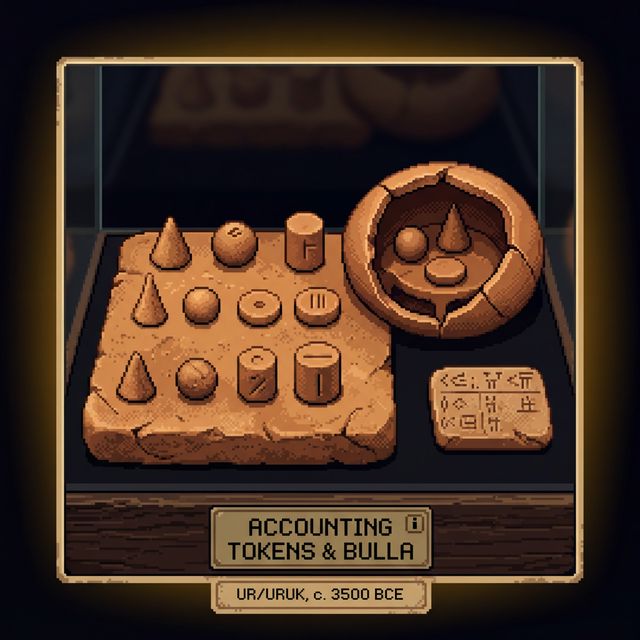
Beginning around 8000 BCE in ancient Mesopotamia, clay tokens of distinctive shapes represented specific commodities: a cone represented a small measure of grain, a sphere represented a large measure, a disk represented an animal. The tokens were physical records of transactions — a jar holding three cones and two spheres meant: three small measures of grain and two large measures were transferred.
By 3500 BCE, the tokens were sealed inside hollow clay balls (bullae) as tamper-evident transaction records. The sealed sphere represented a completed transaction. To verify the contents without breaking the seal, the parties impressed the token shapes into the outside of the clay while it was still wet. If the outside impressions matched the tokens inside, the record was verified.
So: the outside of the envelope recorded what was inside the envelope. Scribes quickly noticed that the impressions on the outside contained all the information that the tokens inside contained, and that breaking the envelope to verify the contents was unnecessary. The impressions alone were sufficient.
This was writing's invention. The calculi are the prototype; cuneiform is the optimization.
The Etymology
The Latin word calculus means "small stone" or "pebble." Roman accountants used pebbles on counting boards — an abacus variant — and the word transferred to the process of reckoning itself. By the time Newton and Leibniz developed differential calculus, the word already meant "method of calculation." The same word root gives us: calculate, calculus, calcium (chalky substance, same root as chalk), and calculator.
Every time a developer runs calculate(), they are etymologically rubbing a pebble on a stone counting board in ancient Rome, which is itself derived from a clay token pressed into a Sumerian envelope in 3500 BCE. The abstraction stack goes further back than we usually look.
The Pattern
The calculi demonstrate the fundamental engineering principle the museum returns to across every era: the format of a record and the content of a record converge when the format is expressive enough. The impression on the outside of the clay envelope was a representation of the tokens inside. When the representation became more convenient to read than the original, the original became redundant. When the original became redundant, it was eliminated. What remained — the impression, the mark, the symbol — was writing.
Every database schema is a clay envelope. Every API is an impression on its outside. If the schema and the API diverge — if what the envelope says is inside doesn't match what's actually inside — you have committed the oldest data integrity failure in human history.
The first data integrity failure was a Sumerian whose clay token impressions didn't match the tokens inside the envelope. We have been documenting this failure, in different languages, ever since.