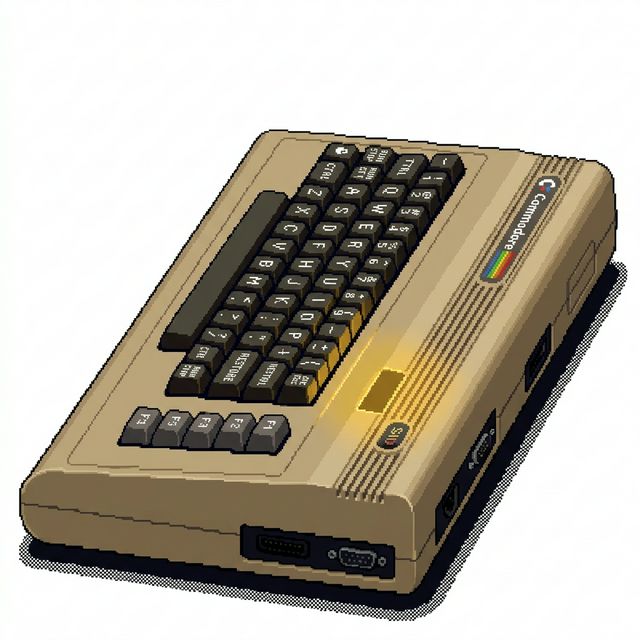
“Computers for the masses, not the classes.”
The Machine
The Commodore 64 launched in August 1982 at $595. Within a year, price competition had brought it below $200. The SID (Sound Interface Device) chip produced three-voice synthesis with independent volume, waveform, and filter control that had no equivalent in the home computer market. The VIC-II graphics chip provided hardware sprites — independently moving objects the CPU didn't need to manage — at a time when Apple II and TRS-80 were drawing everything in software.
Developers discovered you could push the hardware beyond its specifications. DMA tricks, raster interrupts, timing exploits — the C64 demoscene that emerged from these techniques is still active today, forty years later. The machine inspired a form of programming that is closer to the machine as a musical instrument than the machine as a tool.
The Disk Drive
The Commodore 1541 disk drive — the C64's standard storage device — had its own 6502 processor and ran at 300 baud over a serial bus that Commodore had deliberately slowed because the VIC-20 couldn't run the IEEE-488 bus fast enough and they used the same bus for the C64. The disk drive was as powerful as an Apple II and ran at 1/10th the speed it was capable of. Loading a program took minutes. The third-party fast-loader cartridge industry existed entirely because Commodore shipped a crippled serial protocol.
This is an exhibit: an engineering decision made for one product (VIC-20 cost reduction) that became a permanent constraint on a successor product (C64), enforced by hardware compatibility, never fixed in 12 years of production.
The Killing
Commodore International went bankrupt in April 1994. The C64 was still in production. The Amiga — technically superior to both the Mac and the PC for multimedia — had been on the market for nine years and still hadn't been properly marketed. Commodore's engineering teams built machines that were five years ahead of the market. Commodore's management teams failed to market, price, or distribute them.
The C64's death is Complexity Accretion at the corporate layer: each product decision — ignore the Amiga, underprice the C64, cede the business market to IBM, fight price wars instead of building infrastructure — was made independently. The aggregate was the destruction of the most successful home computer company in history.
The best-selling computer in history was killed by the company that made it. The machine outlasted the company. The SID chip inspired musicians for forty years. Commodore's management is documented here as a warning.