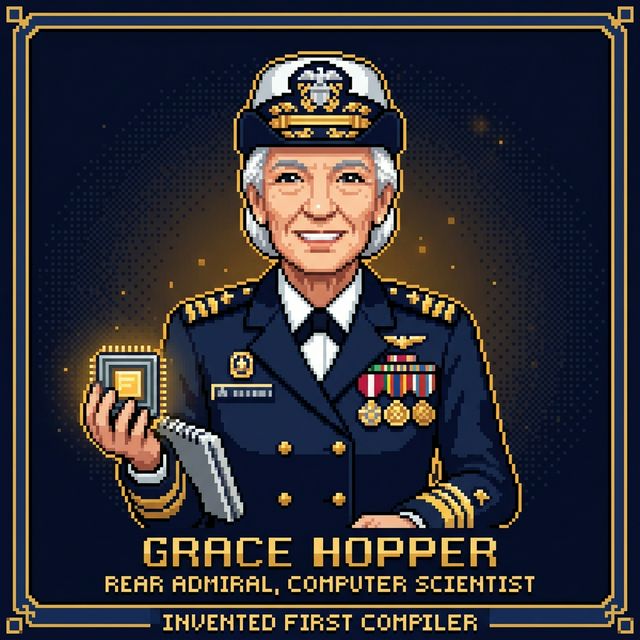
“The most dangerous phrase in the language is, 'We've always done it this way.'”
The Story
Rear Admiral Grace Brewster Murray Hopper spent her career proving that software didn't have to be written in the machine's language — the machine could learn to understand ours.
In 1952, she built the A-0 System, the first compiler — a program that translated mathematical notation into machine code. Her colleagues told her it couldn't be done, that computers could only do arithmetic, not process symbols. She built it anyway. When she presented it, nobody believed it worked. "I had a running compiler and nobody would touch it," she later recalled. "They told me computers could only do arithmetic."
She didn't stop at proof of concept. She pushed for COBOL — the Common Business-Oriented Language — designed so that managers and business analysts could read what a program was doing. COBOL was released in 1960 and was deliberately verbose, using English words like PERFORM, MOVE, and DISPLAY where other languages used cryptic symbols. It was mocked by academic computer scientists. It was also adopted by every bank, insurance company, and government agency that needed reliable transaction processing.
The famous "first bug" story is real, though slightly mythologized. In 1947, operators of the Harvard Mark II found a moth trapped in a relay, causing a malfunction. Hopper taped the moth into the logbook with the note: "First actual case of bug being found." The term "bug" for a malfunction predated this, but Hopper's moth made it folklore — and she loved telling the story.
She served in the United States Navy from 1943 until her retirement in 1986 at age 79, making her the oldest active-duty commissioned officer in the Navy at the time. She was awarded the Presidential Medal of Freedom posthumously in 2016.
Why They're in the Hall
Hopper is Pioneer and Builder in the most literal sense. She didn't just imagine compilers — she built one, fought institutional resistance to get it used, and then spent decades standardizing the idea into COBOL, a language that still processes an estimated 95% of ATM transactions and 80% of in-person transactions worldwide.
Her connection to TechnicalDepth runs deep. COBOL-era patterns are documented in the Exhibits wing's earliest entries — the architectural decisions made in the 1960s that still shape (and constrain) banking and government systems today. Every time an exhibit traces a pattern back to "legacy code that nobody dares rewrite," it's often COBOL code running on design principles Hopper championed.
Her most famous quote — "The most dangerous phrase in the language is, 'We've always done it this way'" — is the founding principle of software archaeology. The entire purpose of TechnicalDepth is to challenge that phrase: to dig into systems, understand why they were built the way they were, and decide whether those reasons still hold.
Hopper didn't just give us tools. She gave us permission to question the tools we inherited.