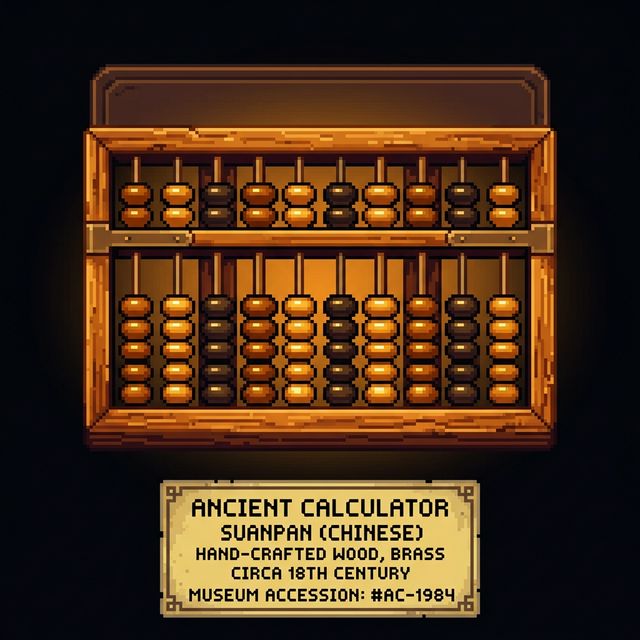
“The abacus is as fast as the person using it. The modern computer is as fast as the algorithm running on it. For most of human history, the person was the bottleneck. This has not changed.”
The Device
The abacus is a frame with beads strung on rods or wires, each position representing a power of ten. Moving a bead toward the center registers its value. The sum of all registered values is the number currently held. To add: move beads. To carry: move ten lower-position beads and reset, move one upper-position bead forward.
That is the complete specification. It has not been substantially improved in 4,700 years.
The Sumerian abacus appears in records around 2700 BCE. The Chinese suanpan appears around 200 BCE. The Japanese soroban — a refined version optimized for speed — was standardized in the 16th century and remains in use today. An experienced soroban operator can add a column of ten 3-digit numbers faster than a person entering the same numbers on a calculator.
The 1946 Race
On November 12, 1946, Sergeant Thomas Nathan Wood of the U.S. Army Finance Disbursing Section — equipped with a Friden electromechanical calculator, considered state of the art — raced Kiyoshi Matsuzaki of the Japanese Post Office Ministry, equipped with a soroban. The race was organized by Stars and Stripes as a demonstration of modern vs. traditional computation.
Matsuzaki won. Four out of five rounds. Addition, subtraction, multiplication, and overall computation: soroban. Division only: the electric calculator.
The lesson was reported as a curiosity. It is actually an architectural insight: the abacus parallelizes carry propagation across all columns simultaneously, where electronic calculators in 1946 had to propagate carries sequentially. The soroban's physical architecture solved a problem that electronic computers didn't solve in hardware until carry-lookahead adders appeared in the 1950s.
The Pattern
The abacus is constructive laziness at its most perfect: the minimal possible physical encoding of positional arithmetic. Each bead has one state: registered, or not. Each position has one meaning: its power of ten. There is no instruction set, no operating system, no boot sequence. The computation is the state of the physical object.
Every abstraction layer added after the abacus was necessary. And every abstraction layer added after the abacus was also an opportunity for a new failure mode. The abacus has no overflow flag. When you have too many beads, you can see it. When your 16-bit integer overflows, you cannot.
The Ariane 5 rocket crashed because a 64-bit float didn't fit in a 16-bit integer. The abacus has been solving that problem for 4,700 years by making the overflow physically visible. We forgot.