“It is easier to change the specification to fit the program than vice versa.”
The Machine
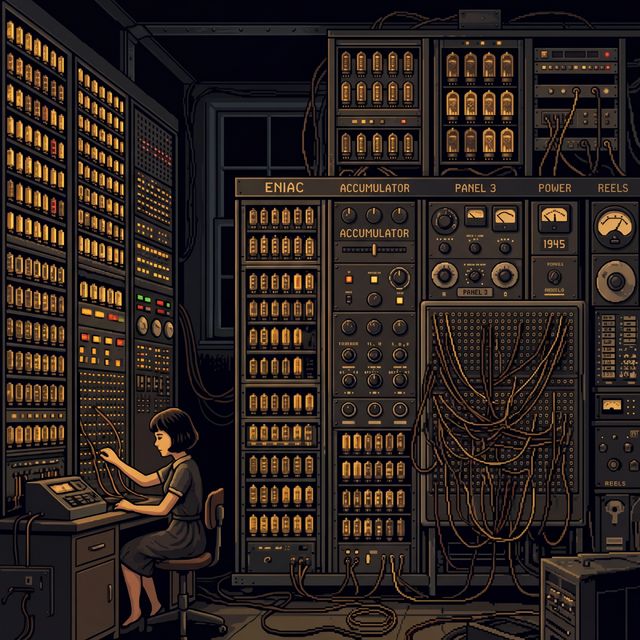
ENIAC — Electronic Numerical Integrator and Computer — was completed in February 1946 at the University of Pennsylvania, funded by the U.S. Army to compute artillery firing tables. It was 100 feet long, 10 feet tall, and contained 17,468 vacuum tubes, 7,200 crystal diodes, 1,500 relays, and 70,000 resistors. It weighed 30 tons and occupied 1,800 square feet.
It computed 5,000 additions per second. For context: your laptop completes roughly 100 billion additions per second. ENIAC was one-twenty-billion'th as fast as the device you might be reading this on.
It was, at the time, the most powerful computational device in human history.
Programming ENIAC
Programming ENIAC was physical. The machine's operations were configured via patch panels — physical cables plugged into a board, routing signals between components. A "program" for ENIAC was a wiring diagram. Changing programs meant physically rewiring the machine. It took days.
The women who programmed ENIAC — Kay McNulty, Betty Jennings, Betty Snyder, Marlyn Meltzer, Fran Bilas, and Ruth Lichterman — are an exhibit in the museum's unwritten section on invisible labor. They were initially referred to as "computers" (the human job title that preceded the machine) and were not invited to the ENIAC dinner celebrating the machine's unveiling.
The Bug
The term "bug" in computing traces to the ENIAC era, though the specific incident is usually attributed to Grace Hopper and the Harvard Mark II in 1947 — a moth found physically trapped in a relay, causing a program failure. The relay was logged as a relay failure. The cause: "First actual case of bug being found." The moth was taped into the logbook.
ENIAC's vacuum tube failures were so frequent that the engineering challenge was not making the tubes reliable — it was writing programs that could complete before a tube failed. Reliability engineering in the ENIAC era meant racing the hardware clock.
Why It Belongs Here
ENIAC is the root node of every exhibit in this museum. Every pattern documented here — every concatenated query, every greedy initializer, every runaway migration — is a descendant of the problems ENIAC's programmers first encountered: how do you write instructions that run correctly on hardware that fails? How do you test a program when "running the test" takes hours of physical configuration? How do you debug when the bug might be a literal insect?
The answers those programmers found — documentation, testing procedures, modular thinking, systematic verification — became software engineering. Before ENIAC, programming was mathematics. After ENIAC, programming was engineering .
30 tons. 150 kilowatts. 5,000 additions per second. The first computer was also the first computer that was too slow, too large, and too unreliable. That hasn't changed. Only the scale has.