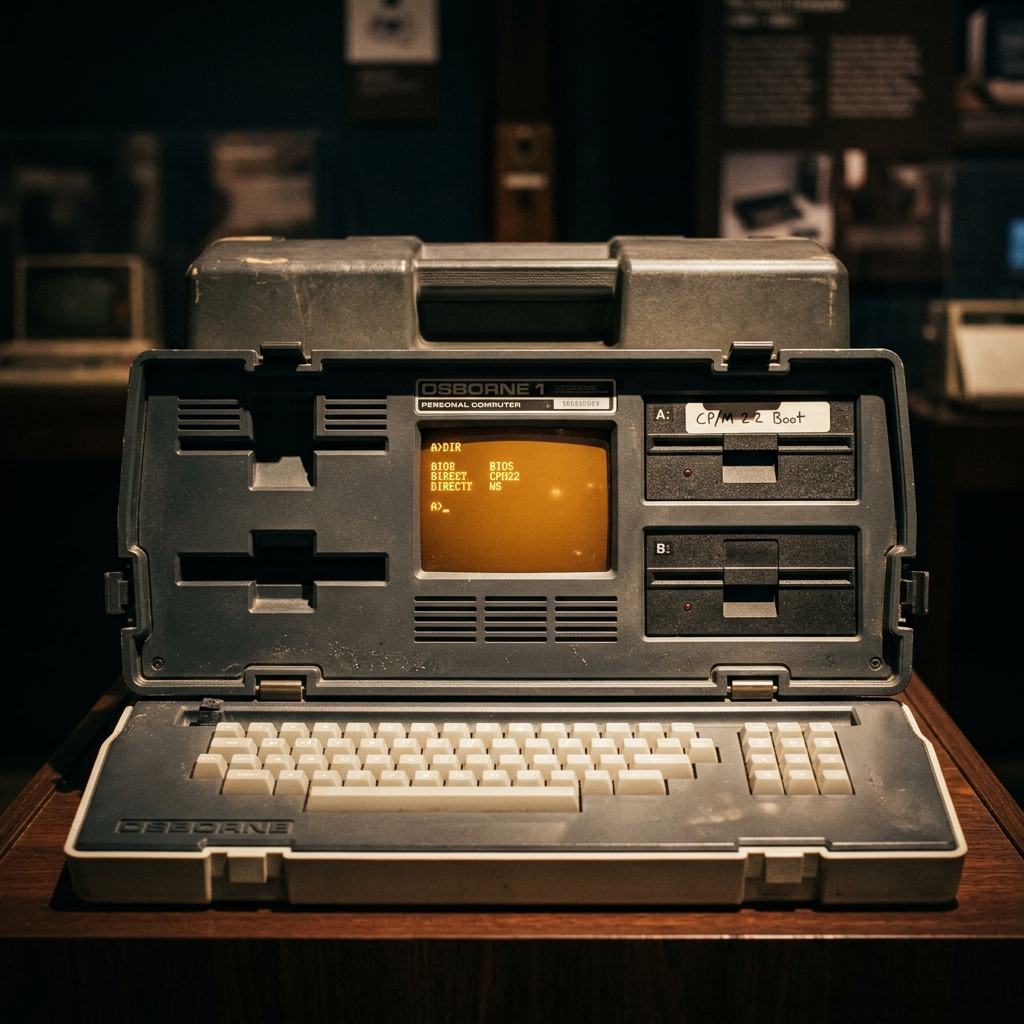
“The first computer you could take on a plane. Also the first company to go bankrupt from announcing its replacement.”
The Machine
On April 3, 1981, at the West Coast Computer Faire in San Francisco, Adam Osborne wheeled out a sewing machine-sized computer in a gray plastic shell and declared it portable. He was technically correct. The Osborne 1 had a handle. It weighed 24.5 pounds. It fit under an airline seat — barely, and probably in violation of modern carry-on regulations.
Inside: a Zilog Z80 running at 4 MHz, 64KB of RAM, two 91KB single-density 5.25-inch floppy drives, and a 5-inch amber phosphor CRT embedded directly into the front panel. The screen was small enough that the bundled software came with utilities specifically designed to scroll horizontally, because no single line of a standard 80-column document could fit on it at once.
It ran CP/M 2.2 — the dominant operating system of professional computing before MS-DOS swept it away.
The Bundle
Like its close competitor the Kaypro II, the Osborne 1's killer feature was not the hardware. It was the box. Every unit shipped with:
- WordStar — the premier professional word processor of the era, sold separately for ~$495
- WordStar MailMerge — for form letters and mass correspondence
- SuperCalc — a full spreadsheet application (~$295 separately)
- Microsoft BASIC and CBASIC — two BASIC interpreters
- dBASE II — a relational database manager (~$700 separately)
The retail value of the bundled software exceeded the purchase price of the machine itself. At $1,795, the Osborne 1 was a genuinely compelling business proposition: buy this computer, receive a complete office software suite as a bonus. Osborne shipped over 10,000 units per month at its peak.
The Osborne Effect
In 1983, Adam Osborne made the announcement that would become a textbook case study in product management failure.
Facing competition from the Kaypro II and the looming IBM PC ecosystem, Osborne began publicly and enthusiastically describing his next machines — the Osborne Executive and the Osborne Vixen — before they were ready to ship. He did this aggressively, at trade shows and in press releases, detailing superior specifications and lower price points.
Sales of the Osborne 1 collapsed immediately. Why buy a machine today when a better one was coming in months? Dealers stopped ordering. Retailers cleared inventory. The company, which had no revenue stream from the unshipped successors, ran out of cash. Osborne Computer Corporation filed for bankruptcy in September 1983 — just 28 months after its triumphant debut.
The "Osborne Effect" entered the business lexicon as the cautionary principle that premature product announcements can cannibalize your own existing revenue. It is cited in MBA programs and product strategy seminars to this day. Apple's supply chain discipline — the absolute refusal to discuss future products — is in part a decades-long institutional response to what Osborne did.
The Legacy
The Osborne 1 is the founding artifact of portable computing. It established that professionals would carry their computers if the value proposition was compelling enough. It pioneered the bundled software model that Kaypro refined and that the entire PC industry eventually adopted. Its Z80/CP/M architecture influenced a generation of business machines.
Lee Felsenstein — who designed the hardware — went on to be a central figure in the Homebrew Computer Club and a foundational voice in the open personal computing movement. The Osborne 1 was his most consequential practical contribution.
The machine did not survive. The company did not survive. But the form factor — the idea that your complete working environment could be packed into a single case and carried through an airport — became the laptop, the Chromebook, and every ultrabook sold today.
The Museum Note
The Osborne 1 is the exhibit on the gap between innovation and execution. Osborne got almost everything right: the form factor, the price point, the software bundle, the timing. The single failure was a communication strategy — an inability to stay quiet about what came next. It is a rare case where the product itself was not the problem. The founder's enthusiasm was.
Adam Osborne gave professionals the first computer they could carry. Then he told them to wait for the next one. They did. He didn't survive the wait.