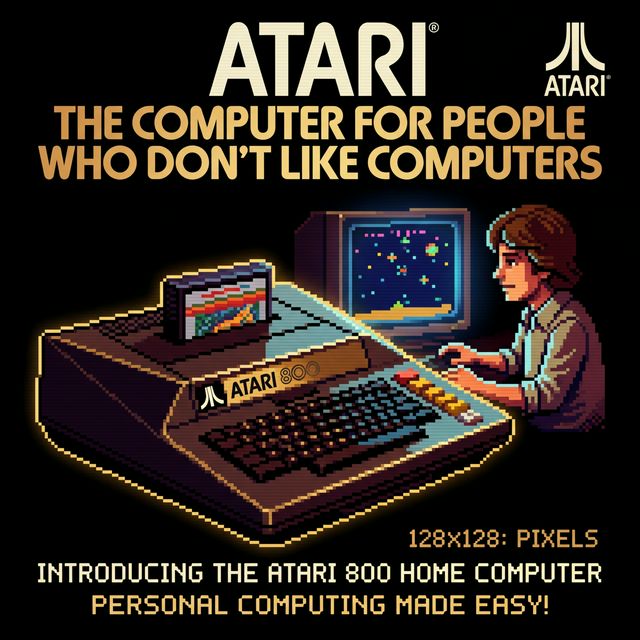
“The Atari 800 had a dedicated graphics coprocessor in 1979. The IBM PC got a comparable chip in 1987. The gap was eight years. Atari didn't survive to collect.”
The Machine
The Atari 400 and 800 launched in 1979. The hardware was designed by Jay Miner and the Atari engineering team — the same Jay Miner who later designed the Amiga custom chips. The Atari 8-bit architecture featured four specialized chips working alongside the 6502 CPU:
ANTIC — the display coprocessor. Managed the screen display independently of the CPU, running its own DMA cycles to fetch display data from RAM. Supported multiple graphics modes including a character mode, a mixed text/graphics mode, and high-resolution bitmap modes.
GTIA — the graphics chip. Implemented Player/Missile graphics: up to four independently positioned sprites (Players) and four smaller sprites (Missiles), hardware-controlled, with collision detection. Colors could be set per-scanline via display list interrupts — a technique that demo coders used to produce effects that technically exceeded the chip's surface specifications.
POKEY — the sound and I/O chip. Four independent audio channels with selectable waveforms, hardware keyboard scanning, and serial communications. POKEY sounds are recognizable: a specific texture of digital audio that shows up in thousands of game soundtracks as the definitive 1979-era 8-bit sound.
The Gap
The Atari 800's graphics capabilities were not matched by the IBM PC until the VGA card in 1987 — eight years later. The Commodore 64's VIC-II chip (1982) was comparable but not superior. The Atari 8-bit hardware was ahead of its time in 1979 and remained competitive into 1985.
The machine's commercial performance did not reflect its technical position. Atari was sold to Warner Communications in 1976. The consumer electronics division and the computer division were managed with different priorities. Inventory management failures, production delays, and marketing decisions that prioritized game consoles over the computer line combined to undermine a technically superior platform.
The Connection
Jay Miner left Atari in 1982. He took his architectural ideas — dedicated coprocessors, hardware sprites, independent audio — to a new project called the Lorraine. The Lorraine became the Amiga. The Atari 800's hardware lineage runs directly into the Amiga's custom chips. The museum tells this as one story, because it is one story.
The Atari 800 had everything it needed to win the home computer market. It had the wrong management at the wrong time. The engineers who built it then went to build the Amiga — which also won technically and also lost commercially. The failure mode was persistent.