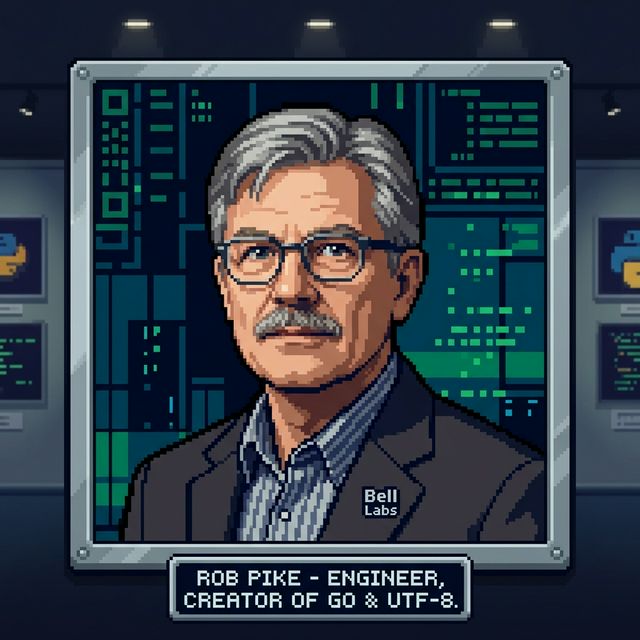
“Simplicity is complicated.”
The Story
Rob Pike joined Bell Labs in 1980 and spent the next two decades at the center of systems programming. He worked on Unix, contributed to the development of the Brio windowing system, co-authored The Unix Programming Environment and The Practice of Programming with Brian Kernighan, and built the Acme editor — a programmer's environment whose design philosophy (text is the universal interface, the mouse is not the enemy) still influences tools today.
After Unix, Pike led the creation of Plan 9 from Bell Labs — an operating system that took Unix's "everything is a file" philosophy and pushed it further: everything is a file on a network. Devices, processes, and network resources all presented the same interface. Plan 9 was too radical for mainstream adoption, but its ideas showed up everywhere: Linux's /proc filesystem, FUSE, 9P protocol, and the general concept that system resources should be accessible through a uniform namespace. Plan 9 was the future that arrived too early.
But Pike's most consequential contribution came from a dinner-time hack. In September 1992, Pike and Ken Thompson designed UTF-8 on a placemat in a New Jersey diner. The problem they solved was fundamental: the world needed a character encoding that could represent every writing system on Earth while remaining backward-compatible with ASCII, the encoding that every existing Unix tool assumed. UTF-8 achieved this with an elegant variable-length encoding — ASCII characters remain single bytes, while characters from other scripts use two to four bytes. The design was so clean that it was adopted as the encoding of the web, of most modern file systems, and of virtually every new protocol designed since.
In 2007, alongside Robert Griesemer and Ken Thompson, Pike co-created Go at Google. He brought the same design sensibility he'd applied to Plan 9 and UTF-8: do less, but do it correctly. Go's concurrency model (goroutines and channels) descends directly from ideas Pike had explored in his earlier work on concurrent programming with Newsqueak and Limbo.
Why They're in the Hall
Pike is Pioneer and Builder — someone whose contributions operate at the infrastructure layer that most developers never see but depend on every day.
Pioneer: UTF-8, co-designed with Ken Thompson, is one of the most successful standards in computing history. Before UTF-8, character encoding was a disaster. ASCII assumed English. ISO 8859 fractured into regional variants. Shift-JIS, EUC-KR, Big5 — every region had its own encoding, and data that crossed regional boundaries was corrupted. Every mojibake error, every garbled email, every "why are there weird characters in my database" bug traces back to the pre-UTF-8 world.
UTF-8 didn't just solve the encoding problem — it solved it in a way that was backward-compatible with the billions of lines of ASCII-assuming code already in production. Existing C string functions still worked. Existing file paths still worked. The migration path was so smooth that most of the internet switched without most developers noticing. That's the hallmark of a great standard: it solves the problem so completely that people forget the problem existed.
The data integrity implications are profound. Every exhibit in TechnicalDepth that involves data corruption, data loss, or data misinterpretation has a cousin in the encoding wars. Pike and Thompson's solution didn't just fix text — it demonstrated that a carefully designed encoding scheme can prevent entire categories of bugs from existing.
Builder: Go, Plan 9, Acme — Pike builds systems that embody his philosophy: "Simplicity is complicated." It takes more effort to design something simple than to design something complex. Complex systems accrete naturally; simple systems require discipline and taste.
This philosophy is a direct counter to the complexity that generates the bugs documented in TechnicalDepth's Exhibits wing. Every exhibit that traces a failure to "the system was too complex for anyone to fully understand" is an argument for Pike's approach. His career is a demonstration that simplicity isn't a compromise — it's the hardest and most valuable engineering outcome there is.