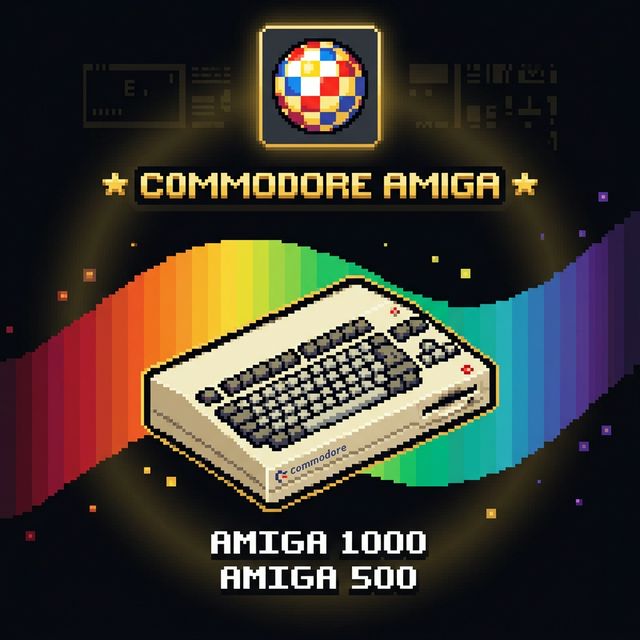
“The computer for the creative mind.”
The Machine
The Amiga 1000 launched in July 1985. It had three custom chips that no competitor would match for years:
Agnus — the DMA controller and blitter. Managed memory access and performed 2D graphics operations (fill, copy, line draw) independently of the CPU.
Denise — the display chip. Supported up to 64 colors in standard mode and 4,096 colors in HAM (Hold and Modify) mode, at a time when the original Macintosh displayed black and white pixels.
Paula — four-channel PCM digital audio with hardware mixing. The Amiga could play four audio channels simultaneously from chip RAM without CPU involvement, at a sample quality that PC soundcards wouldn't reach until Sound Blaster Pro in 1992.
The OS — AmigaOS — had preemptive multitasking in 1985. You could run multiple applications simultaneously. On a 7.16 MHz processor with 256KB of RAM. While playing audio. While rendering graphics. This was the year IBM released the PC XT with a 10MB hard drive as a premium upgrade.
The Murder
Commodore purchased Amiga Inc. in 1984 for $27.5 million — one of the greatest technology acquisitions in history, immediately mishandled. The company marketed the Amiga as a gaming machine at a time when "game computer" meant "toy." The technical press that reviewed it understood what it was. The sales force did not.
The Amiga 2000, released in 1987, was a professional workstation. NewTek's Video Toaster — a broadcast production system that replaced $100,000 of television equipment for $1,595 — ran exclusively on the Amiga 2000. Television shows including SeaQuest DSV and Babylon 5 used Amigas for effects in the early 1990s. Commodore's marketing did not mention any of this.
In 1994, Commodore International went bankrupt. The Amiga's successor — in development since 1990 — never shipped. The machine that had preemptive multitasking in 1985 watched Windows 95 sell as a revolution for adding preemptive multitasking in 1995.
The Exhibit
The Amiga is the museum's clearest example of innovation without distribution: the technology was real, the applications were validated (Video Toaster, demo scene, video production), and the company responsible for distributing it failed at every layer — pricing, marketing, retail, developer relations, and executive vision. The machine was five years ahead. The company was ten years behind.
In 1985, the Amiga was playing four channels of digital audio and rendering 4,096 colors. In 1992, Microsoft was selling DOS 6. The Amiga died not because it was wrong. It died because the people who owned it didn't know what it was.