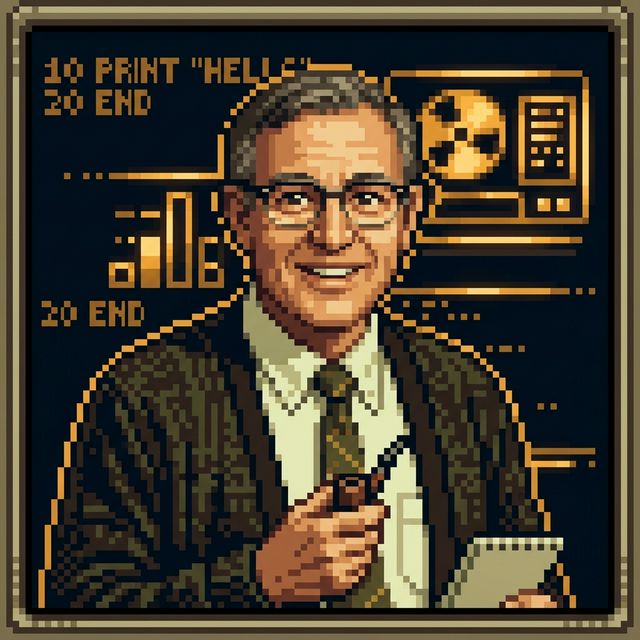
“We were thinking of the students. BASIC was designed for a broad audience, not for computer professionals.”
The Story
In the spring of 1964, at 4:00 AM on May 1st, two programs written in a new language called BASIC ran simultaneously on a General Electric GE-225 at Dartmouth College. Thomas Kurtz and John Kemeny had just proved their thesis: programming didn't have to be the exclusive domain of specialists.
The context matters. In the early 1960s, writing a program meant punching cards, submitting a batch job, and waiting hours or days for output. FORTRAN and COBOL existed but demanded expertise. Kurtz and Kemeny — both mathematicians, not computer scientists — believed that computing was too important to remain behind that barrier.
BASIC (Beginner's All-purpose Symbolic Instruction Code) was deliberately simple. Line numbers. GOTO. PRINT. INPUT. No data types to declare, no memory to manage, no compilation step to wait for. You typed a program, typed RUN, and something happened immediately. The Dartmouth Time-Sharing System let dozens of students use the same computer simultaneously, each getting an interactive session.
The design made trade-offs that purists hated. No structured programming. No scoping. Global everything. GOTO as the primary flow control. These weren't oversights — they were decisions. Kurtz and Kemeny understood that a language requiring knowledge of structured programming before you could print "HELLO WORLD" wasn't a language for beginners. They chose accessibility over structure, knowing the cost.
BASIC spread everywhere. It was ported to minicomputers, embedded in ROM on early microcomputers, and became the first programming language for an entire generation. The Apple II, the Commodore 64, the TRS-80 — they all booted to a BASIC prompt. Bill Gates and Paul Allen wrote Altair BASIC in 1975, and Microsoft was born.
The lineage runs through decades. BASIC begat GW-BASIC, which begat QBasic, which begat Visual Basic, which begat VBA and VB.NET. Each generation added structure — subroutines, then functions, then objects, then proper scoping — but the DNA of accessibility persisted.
Thomas Kurtz continued working on BASIC for decades, developing True BASIC in the 1980s — an attempt to modernize the language with structured programming while preserving its approachability. He died in November 2024, sixty years after that first 4 AM run.
Why They're in the Hall
Kurtz is a Pioneer and Builder whose impact is measured not in technical sophistication but in reach.
Pioneer: Before BASIC, programming was a priesthood. After BASIC, it was something a 12-year-old could do on a Saturday morning. That transition — from expert craft to accessible skill — is the most consequential shift in computing history. Every "learn to code" initiative, every drag-and-drop programming environment, every low-code platform owes a debt to the principle Kurtz and Kemeny established: programming should be for everyone.
Builder: The language itself is the artifact. It shipped on millions of machines. It was the first code millions of people ever wrote. The VB6 developers whose initialization patterns populate the Greedy Initializer exhibit — they trace their lineage through BASIC. The language that taught them to program shaped how they thought about programming, for better and for worse.
The trade-off Kurtz made — accessibility over structure — is the kind of deliberate design decision that TechnicalDepth exists to examine. GOTO wasn't a mistake. Global state wasn't ignorance. They were choices made for a specific audience, with consequences that played out over generations. BASIC taught a generation to program. It also taught them patterns they'd spend the next generation unlearning. Both of those outcomes were real, and neither invalidates the other.