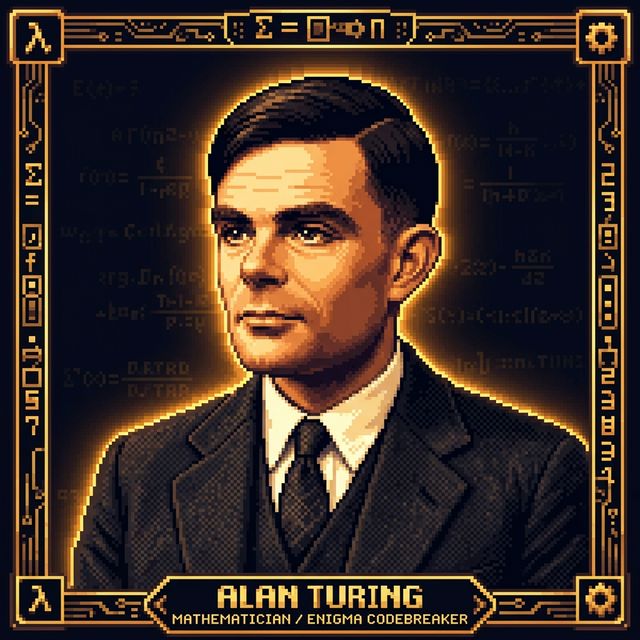
“We can only see a short distance ahead, but we can see plenty there that needs to be done.”
The Story
Alan Turing's 1936 paper "On Computable Numbers" didn't describe a machine — it described the limits of all possible machines. The Turing machine was a thought experiment that formalized what it means to compute, proving that some problems are undecidable and that a single universal machine could simulate any other.
During World War II, he led the team at Bletchley Park that broke the Enigma cipher — arguably the first large-scale cryptanalysis operation and the first demonstration that computational thinking could be applied to security at a national scale. The Bombe, the electromechanical device his team built, was a special-purpose breaker — a machine designed to find the flaw in another machine's logic.
After the war, he designed the ACE (Automatic Computing Engine) at the National Physical Laboratory — one of the earliest stored-program computer designs. He wrote what may be the first chess-playing algorithm, simulating it by hand before any computer could run it.
In 1950, he published "Computing Machinery and Intelligence," proposing the Turing Test and asking whether machines could think — launching the field of artificial intelligence.
In 1952, he was prosecuted for homosexuality, subjected to chemical castration, and died in 1954. He was pardoned posthumously in 2013. The "Alan Turing law" retroactively pardoned thousands of others convicted under the same statute.
Why They're in the Hall
Turing is Pioneer, Breaker, and Builder simultaneously.
Pioneer: He formalized computation before computers existed. Every programming language, every algorithm, every exhibit in TechnicalDepth operates within the theoretical framework he defined. The concept that a program is a sequence of symbols manipulated by rules — that's Turing.
Breaker: Enigma was a cryptographic system that its designers believed was unbreakable. Turing's team found the pattern — the structural flaw in how operators used the machine — and exploited it. This is software archaeology at its most consequential: finding the pattern in someone else's system, understanding why it was built that way, and using that understanding to break it.
Builder: The ACE, the Bombe, the chess algorithm — Turing didn't just theorize. He built. And his designs influenced every machine that followed.
His persecution and death are a reminder that the history of computing is not just a history of machines. The people who built this field were human, and the institutions they worked within had flaws far worse than any documented in the Exhibits wing.