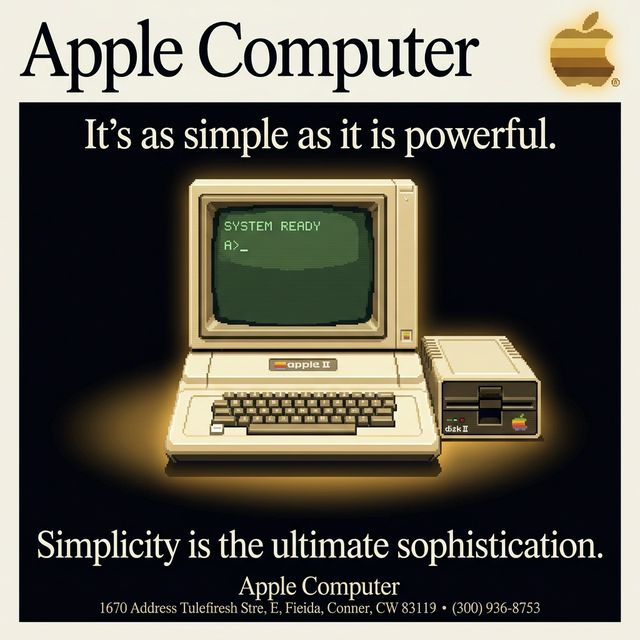
“The Apple II was supposed to be a product for hobbyists. VisiCalc made it a tool for business. That's the thing about platforms — users decide what they're for.”
The Machine
Steve Wozniak designed the Apple II in 1976-1977 as a clean-sheet redesign of the Apple I — not to improve the Apple I marginally, but to eliminate its constraints entirely. The Apple II had color graphics. It had sound. It had eight expansion slots that accepted third-party cards. It had Applesoft BASIC in ROM. It had a cassette interface and later a floppy disk interface.
The design philosophy was Wozniak's: minimize chip count, maximize elegance. The Apple II used 62 chips; a comparable S-100 bus machine used 100+. This was not just aesthetic — fewer chips meant lower cost, higher reliability, and a simpler hardware schematic that third-party developers could understand and extend.
VisiCalc launched on the Apple II in October 1979. The first spreadsheet application turned the Apple II into a business tool that cost $1,995 instead of a minicomputer that cost $100,000. Accountants, business analysts, and corporate buyers who had no interest in hobbyist computing bought Apple IIs to run VisiCalc. The computer was the platform; the spreadsheet was the product.
The Education Machine
The Apple IIe (Enhanced, 1983) became the dominant computer in American public schools through a combination of durability, software availability, and Apple's education pricing program. By 1985, Apple had sold computers to schools at discounted prices as part of a California bill that allowed companies to donate computers to schools for a tax credit.
The Oregon Trail. Logo. Bank Street Writer. These were the experiences of an entire generation of American students. The Apple IIe was the first computer for millions of people who are now software engineers, product managers, and executives — their first exposure to computing happened on a 1 MHz, 64KB machine with a green phosphor display.
The Longevity
The Apple II line ran from 1977 to 1993 — 16 years of production, encompassing the IIe (1983) and the IIc portable (1984). The IIc was the first computer to include a carrying handle as standard. It predated the MacBook by 20 years. The Apple II platform outlasted the Apple III (discontinued 1984), the Apple Lisa (discontinued 1985), and the original Macintosh line (discontinued 1987).
The machine Steve Jobs wanted to cancel in 1985 to protect Macintosh sales was still generating revenue after the Macintosh had been revised twice.
VisiCalc didn't run on the Apple II because Apple planned for it. It ran on the Apple II because Wozniak built a machine with open expansion slots and a robust enough platform that Dan Bricklin and Bob Frankston could build on it. The platform didn't know what it would become. Platforms never do.