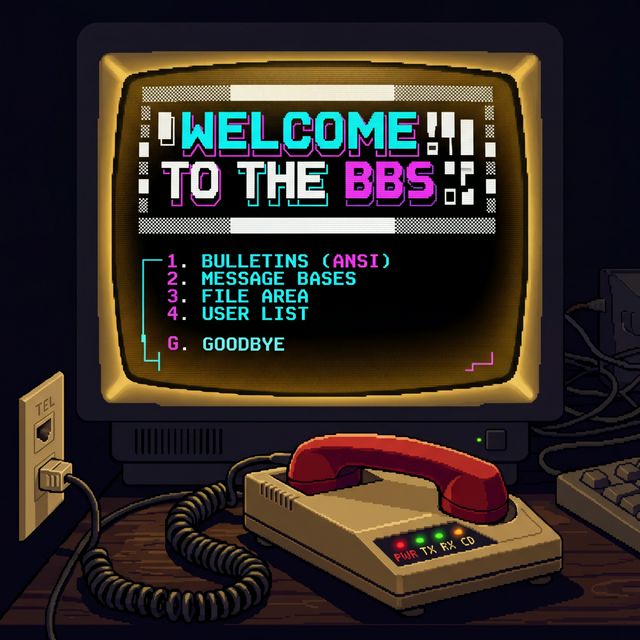
“The BBS was the internet before the internet decided to scale. Everything that happened on the internet happened on BBSes first, including the failures.”
The System
On February 16, 1978, a blizzard shut down Chicago. Ward Christensen and Randy Suess, both members of the Chicago Area Computer Hobbyist's Exchange, were stuck indoors. Christensen had been developing a file transfer protocol (which he would call XMODEM). Suess had been thinking about a computerized message board. During the blizzard, they built both. The first caller reached CBBS — Computerized Bulletin Board System — on February 16, 1978. It ran continuously for until 1993.
A BBS was a personal computer, connected to one or more phone lines via modems, running software that answered incoming calls and presented callers with a text menu. You could read messages posted by previous callers, post your own, download files, play games, and in later years connect to other BBSes via FidoNet — a store-and-forward email and message network that routed messages between systems overnight when phone rates were lowest.
What BBSes Built
File sharing — Software, music files (MODs, XMs), games, and document archives. The BBS invented the software distribution ecosystem that made shareware and freeware possible. Everything that became "the App Store" started as a BBS file section.
Online community — Message bases organized by topic, real-time chat systems (multi-line BBSes), door games (online multiplayer RPGs and strategy games). The BBS invented the social dynamics — flame wars, trolling, moderator drama, ingroup/outgroup formation — that the modern internet rediscovered and scaled.
Hacker culture — the BBS was where the early hacking community shared techniques, tools, and the Hacker Ethic. Phrack magazine distributed via BBS from 1985. The security community (and its adversaries) formed on BBSes before moving to Usenet and then the web.
Software piracy — "Warez" BBSes were dedicated file share networks for commercial software. The content moderation failure mode was identical to what platforms face today: how do you allow free speech and file sharing while preventing your platform from becoming a distribution channel for illegal content? Sysops solved it with manual curation, community trust levels, and access tiers — the same answers modern platforms use, reinvented every decade.
The Failure Modes
The BBS era produced every social failure mode that the web later reinvented at scale:
- Trust hierarchies that excluded newcomers ("elite" access levels, cryptic verification rituals)
- Sysop as single point of failure (one person controlling moderation, topic policy, and access)
- No portability (your posts, reputation, and relationships lived on one system; if it shut down, everything was gone)
- Monoculture fragility (each BBS ran one software package; a vulnerability in TBBS, RBBS, or PCBoard affected every board running that software)
The BBS died when the World Wide Web arrived — not because the web was better at what BBSes did, but because the web was open and geographically infinite and free. The dial-up BBS was local by economic necessity: your phone bill constrained your reach. The web removed that constraint. The constraint had also, incidentally, enforced a community size that maintained social cohesion.
The Inheritance
Every failure pattern on the modern internet was documented on a BBS first. The difference is scale. A BBS with 500 active callers was large. When the same dynamics scale to 500 million active users, the failure modes are identical in character and catastrophic in consequence.
The BBS is the museum's exhibit on what happens when you solve the technical problem (networked communication) before solving the social problem (what do communities need to function). The internet inherited the solution. It also inherited the unsolved problem.