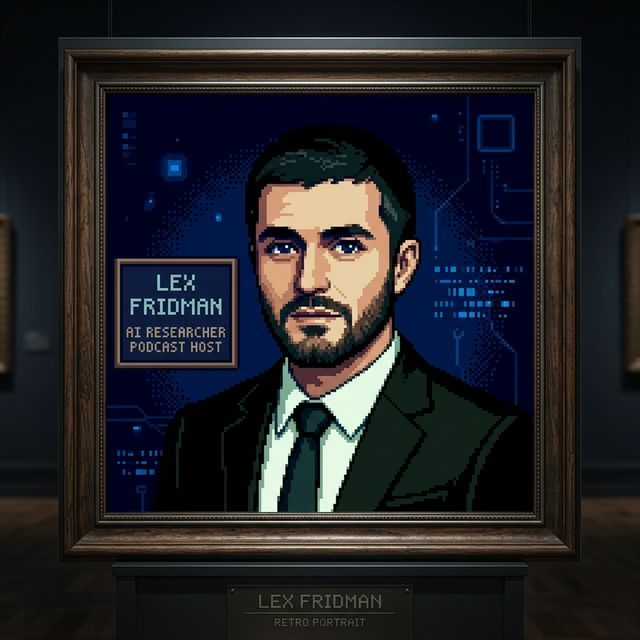
“I think the most beautiful thing about science is that it can be wrong.”
The Story
Lex Fridman's contribution to technology isn't a language, an algorithm, or a system. It's a microphone, a camera, and three hours of patience.
The Lex Fridman Podcast — which began as the MIT Artificial Intelligence Podcast around 2018 — has grown into the primary venue where deep technical ideas reach audiences of millions. The format is simple: Fridman sits down with a guest for two, three, sometimes four or more hours, and they talk. No rapid-fire segments. No soundbite optimization. No producer cutting to commercial. Just a conversation that goes wherever the guest's expertise leads.
The guest list reads like a roll call of computing history and its living practitioners. Donald Knuth discussed the art of programming and his decades-long work on TAOCP. Linus Torvalds talked about the social and technical dynamics of Linux kernel development. John Carmack described the engineering decisions behind id Software's game engines. George Hotz explained the philosophy behind comma.ai and tinygrad. Guido van Rossum discussed Python's design. Jim Keller talked about chip architecture. The list extends across hundreds of episodes spanning computer science, mathematics, physics, biology, philosophy, and the humanities.
Fridman's academic background anchors the technical conversations. He researched autonomous vehicles and human-robot interaction at MIT, publishing work on driver behavior analysis and the integration of AI systems into human environments. He understands machine learning at the implementation level, which means he can ask follow-up questions that a generalist interviewer would miss. When a guest mentions a specific neural network architecture or optimization technique, Fridman can engage with the details rather than nodding and moving on.
His interview style is distinctive: quiet, deliberate, willing to sit in silence while a guest formulates a thought. He asks open-ended questions and lets guests run. This draws out a kind of reflection that rapid-fire podcast formats systematically prevent. When Knuth pauses for twenty seconds to consider how to explain the beauty of a particular algorithm, Fridman waits. That patience is a feature, not a flaw. It produces moments of genuine insight that would be edited out of any broadcast-format show.
The result, accumulated over years and hundreds of episodes, is something that didn't exist before: a public, searchable, freely accessible archive of engineering philosophy and technical depth. It's not a textbook. It's not documentation. It's the oral history of a field in real time, captured in a format that preserves nuance, complexity, and the pauses where understanding lives.
Why They're in the Hall
Fridman earns the Voice designation because his platform has become the connective tissue between deep technical expertise and public understanding.
TechnicalDepth is, at its core, a museum — a place where patterns, failures, and insights are preserved and made accessible. Fridman's podcast does the same thing in a different medium. When he interviews Knuth for three hours, the resulting conversation covers topics that span every floor of TechnicalDepth's conceptual museum: algorithm design, the aesthetics of code, the relationship between mathematical proof and engineering practice, the patience required to do fundamental work. When he interviews Torvalds, the conversation touches on open-source governance, code review culture, the social dynamics of large engineering projects, and the specific technical decisions that made Linux the foundation of modern infrastructure.
These conversations don't live behind paywalls. They're on YouTube, freely available, with millions of views. A twenty-year-old computer science student in Lagos or Lahore can watch Knuth explain his life's work with the same access as a Stanford postdoc. This matters. Technical knowledge has historically been gated by institutional access — you needed to be at the right university, in the right lab, knowing the right people. Fridman's archive lowers that gate.
His format also embodies a principle TechnicalDepth takes seriously: some ideas require time to develop. A three-hour conversation is not inefficient. It is exactly as long as it needs to be to get past the rehearsed talking points and into the territory where a guest says something they've never articulated before. The first hour is warm-up. The second hour is substance. The third hour is where the unexpected insights live. This mirrors TechnicalDepth's own structure — you can't understand a complex system failure in a tweet or a five-minute video. You need depth. You need context. You need time.
Fridman is also a notable outreach vector for TechnicalDepth itself — not as a product pitch, but as a thesis conversation. His audience self-selects for intellectual curiosity and tolerance for depth. The TechnicalDepth thesis — that human pattern-recognition across sixty years of software history is a better compass than any framework or methodology — is exactly the kind of idea his format is designed to explore. The connection is natural, not manufactured.
In a media environment that rewards brevity, hot takes, and engagement metrics, Fridman has built an audience by doing the opposite: going long, going deep, and trusting that the audience will follow. TechnicalDepth makes the same bet.