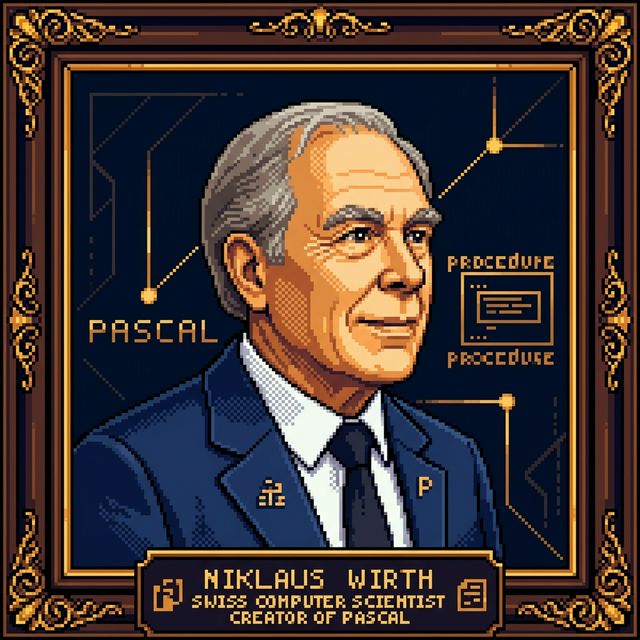
“Software is getting slower more rapidly than hardware becomes faster.”
The Story
Niklaus Wirth spent his career trying to make programming disciplined. In an era when software was written like prose — flowing, unstructured, full of GOTOs jumping to arbitrary locations — Wirth argued that programs should be engineered like bridges: structured, provably sound, and built from well-defined components.
Pascal, released in 1970, was his most influential argument. Designed explicitly for teaching, it enforced structure at the language level. Strong typing caught mismatches at compile time. Block structure replaced spaghetti code with nested, readable control flow. Pointer arithmetic — the footgun that makes C both powerful and dangerous — was absent by default. Pascal said: you don't need unconstrained power to write correct programs. In fact, unconstrained power is what makes programs incorrect.
Pascal became the standard teaching language at universities worldwide throughout the 1970s and 1980s. But it didn't stay in the classroom. Borland's Turbo Pascal, released in 1983, was a revelation: a full compiler and integrated development environment that ran on an IBM PC, compiled nearly instantly, and cost $49.95. It democratized compiled-language development on personal computers. Suddenly, hobbyists and small businesses could write fast, structured programs without mainframe access.
Wirth didn't stop at Pascal. Modula-2 added modules and coroutines — encapsulation and concurrency, the two features Pascal lacked for large-scale systems. Oberon went further still: an entire operating system and language designed together, with the explicit goal of being small enough for one person to understand completely. The Oberon system, including compiler, editor, and OS, fit in a remarkably small codebase. It was a proof by construction that software didn't have to be bloated.
Then there is Wirth's Law, his most bitter and prescient observation: "Software is getting slower more rapidly than hardware becomes faster." Coined in 1995 as a counterpoint to Moore's Law, it captured the reality that hardware improvements were being consumed not by new capabilities but by software inefficiency — larger frameworks, more abstraction layers, more features nobody asked for.
Wirth died on January 1, 2024, at the age of 89.
Why They're in the Hall
Wirth is Pioneer and Builder — and his work connects directly to some of TechnicalDepth's most documented patterns.
Pioneer: Structured programming is so fundamental now that it's invisible. Nobody argues for GOTO-based control flow anymore. Nobody ships programs without block structure, without type checking, without modular decomposition. These ideas had to be fought for, and Wirth was among those who fought hardest. Pascal didn't just teach a generation of programmers how to code — it taught them that code should have structure, that types exist for a reason, and that constraints are features, not limitations.
Builder: Pascal's descendants power more of the software world than most people realize. Turbo Pascal evolved into Delphi (Object Pascal), which powered a generation of Windows desktop applications — including the kind of enterprise software documented in the Greedy Initializer exhibit. Delphi applications are still running in production at companies worldwide: point-of-sale systems, medical records software, accounting tools. When TechnicalDepth's exhibits trace a pattern to "legacy desktop application," there's a meaningful chance that application was written in a language Wirth designed or directly inspired.
But Wirth's most enduring contribution to TechnicalDepth's themes is Wirth's Law. It is the meta-pattern behind half the performance exhibits in the archive. Every exhibit that documents a system slowing down over time, every case study of startup times growing from milliseconds to seconds to minutes, every analysis of memory usage expanding to fill available RAM — these are all instances of Wirth's Law in action. Hardware gets faster. Software gets slower faster. The net result is that users in 2026 wait longer for their applications to load than users in 1996, despite hardware being thousands of times more powerful.
Wirth saw this coming thirty years ago. He spent his career building languages and systems that proved it didn't have to be this way — that software could be small, fast, and correct if designers had the discipline to make it so. The industry largely ignored him. The exhibits document the consequences.