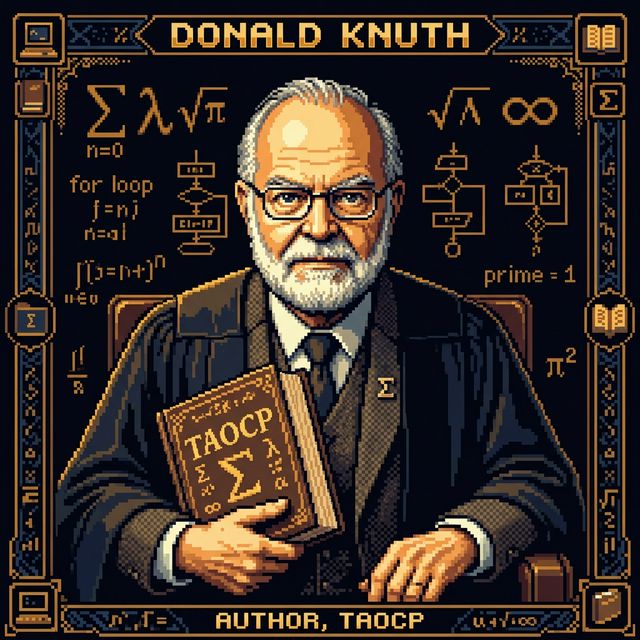
“Premature optimization is the root of all evil.”
The Story
In 1962, a twenty-four-year-old mathematician named Donald Knuth signed a contract to write a single book about compiler design. Sixty-plus years later, that book has become a multi-volume series called The Art of Computer Programming — widely regarded as the most important work in computer science — and it is still not finished.
TAOCP is not a textbook in the conventional sense. It is an attempt to be the definitive, comprehensive, mathematically rigorous treatment of fundamental algorithms and data structures. Volume 1 (Fundamental Algorithms) appeared in 1968. Volume 2 (Seminumerical Algorithms) in 1969. Volume 3 (Sorting and Searching) in 1973. Volume 4A (Combinatorial Algorithms, Part 1) in 2011. Fascicles of Volume 4B appeared in 2022. Each volume is dense, precise, and written in a style that assumes the reader is willing to work — really work — to understand the material.
Bill Gates reportedly said: "If you think you're a really good programmer, read Art of Computer Programming. You should definitely send me a resume if you can read the whole thing." The comment is telling. TAOCP is not meant to be skimmed. It is meant to be studied, the way a graduate student studies mathematics: with pencil in hand, working through the exercises, proving the theorems, understanding not just that an algorithm works but why it works, and what its precise computational cost is under every input distribution.
Knuth's analysis of algorithms — his systematic application of mathematical tools to determine the exact running time and resource consumption of code — is the foundation of computational complexity as a practical discipline. Before Knuth, programmers had intuitions about what was fast and what was slow. After Knuth, they had proofs. Big-O notation existed before him, but Knuth popularized it as the standard vocabulary for discussing algorithmic performance. Every time a programmer says "that's O(n log n)" or debates whether a hash table lookup is really O(1), they're using the framework Knuth formalized.
Then there's TeX.
In the late 1970s, Knuth received the galley proofs for the second edition of Volume 2 of TAOCP. The typesetting was terrible. The publisher had switched to a new phototypesetting system that couldn't properly handle mathematical notation. Most authors would have complained to the publisher. Knuth wrote his own typesetting system.
TeX (pronounced "tech," from the Greek root for art and skill) took Knuth about ten years to complete. It is a programmable typesetting engine of extraordinary precision — capable of placing characters on a page with accuracy measured in fractions of a micrometer. It handles mathematical notation, paragraph breaking, hyphenation, and page layout with algorithms that Knuth designed and proved optimal. Nearly fifty years later, TeX and its derivative LaTeX remain the universal standard for academic publishing in mathematics, physics, and computer science. Every scientific paper with properly typeset equations almost certainly passed through Knuth's system.
Knuth also introduced the concept of literate programming — the idea that programs should be written primarily as documents meant for humans to read, with the code embedded in the explanation rather than the explanation embedded in the code. The tool he built for this, WEB (and later CWEB), allows a programmer to write a narrative document that weaves together prose and code, which can then be "tangled" into compilable source or "woven" into a formatted document. The concept influenced every documentation-first methodology that followed.
And then there are the checks. Knuth offers $2.56 (one hexadecimal dollar: 0x$1.00) to anyone who finds an error in his published works. The checks became collector's items — so prized that most recipients frame them rather than cash them. In 2008, Knuth stopped writing physical checks because too many people were systematically searching his books for errors as a profit-making activity rather than a scholarly one, and the bank processing costs had become absurd. He now issues "personal certificates of deposit" at the fictitious Bank of San Serriffe.
Knuth received the Turing Award in 1974 at age 36, for "major contributions to the analysis of algorithms and the design of programming languages, and in particular for his contributions to the 'art of computer programming' through his well-known books in a continuous series by this title."
Why They're in the Hall
Knuth is a Pioneer and Builder who occupies a unique position in TechnicalDepth: he is the person who proved that the patterns in the museum are real — that software behavior can be analyzed with the same rigor as physics or mathematics, and that the results of that analysis are precise, predictive, and non-negotiable.
Every exhibit in the complexity domain rests on the analytical foundation Knuth built. When an exhibit shows that a naive algorithm is O(n^2) and its replacement is O(n log n), that notation and that methodology are Knuth's contribution. When a disaster post-mortem traces a production outage to an algorithm that performed well in testing but collapsed under real-world data distributions, the framework for understanding why — average-case vs. worst-case analysis, amortized complexity, the behavior of algorithms under non-uniform inputs — is work Knuth pioneered.
His most famous quote — "Premature optimization is the root of all evil" — is the most cited sentence in software engineering, and also the most misquoted. The full passage, from his 1974 paper "Structured Programming with go to Statements," reads: "We should forget about small efficiencies, say about 97% of the time: premature optimization is the root of all evil. Yet we should not pass up our opportunities in that critical 3%." The nuance matters. Knuth isn't saying optimization is bad. He's saying optimization without measurement is bad — that you must first understand where the actual bottlenecks are before you optimize, and that wasting effort optimizing non-critical code is worse than leaving it alone. This is the intellectual foundation for every profiling-first, data-driven performance methodology in modern engineering.
His other remark — "Beware of bugs in the above code; I have only proved it correct, not tested it" — captures something profound about the gap between theory and practice. Formal proof and empirical testing are complementary, not interchangeable. A proof tells you the logic is sound. A test tells you the implementation matches the logic. You need both. This duality runs through TechnicalDepth's architecture domain: systems fail when engineers trust one verification method to do the work of two.
TeX deserves its own consideration. Knuth built TeX because the existing tool couldn't do what he needed. He didn't file a bug report. He didn't switch publishers. He didn't compromise. He spent a decade building a system that solved the problem correctly, completely, and permanently. TeX has been stable since 1982; its version number asymptotically approaches pi (currently 3.141592653). This is what engineering without compromise looks like, and it's the standard TechnicalDepth holds up as the ideal.
Knuth is still writing. Still working on Volume 4. Still adding to a body of work that began before most practicing programmers were born. His career is the longest-running argument in computer science that depth matters more than breadth, that rigor matters more than speed, and that getting it right matters more than getting it shipped. In a field addicted to velocity, Knuth is the quiet, irrefutable case for patience.